
Corporate shareholders don’t automatically prevent a Singapore private company from qualifying for audit exemption; it may qualify if it remains private and meets at least two of three thresholds for the immediate past two consecutive financial years: annual revenue of S$10 million or less, total assets of S$10 million or less, and no more than 50 employees. If it doesn’t qualify for an exemption, a statutory audit in Singapore is required.
A statutory audit in Singapore examines more than the figures in your accounts. The auditor also needs records that support transactions and show how they were approved and recorded. This guide explains the documents commonly reviewed and how the audit opinion communicates the auditor’s findings.
You’ll also learn what auditors and directors must do and how internal controls fit into the process, so you can understand the requirements and prepare for a timely, accurate audit.
Key Takeaways
- Organise the records that help an auditor trace transactions and assess your financial statements.
- Understand what an audit opinion says about the presentation of your company’s financial statements.
- Know when your company must appoint an auditor and how appointment and filing deadlines fit together.
- Clarify the respective responsibilities of directors and auditors during the statutory audit process.
What documents should you provide for a company statutory audit?
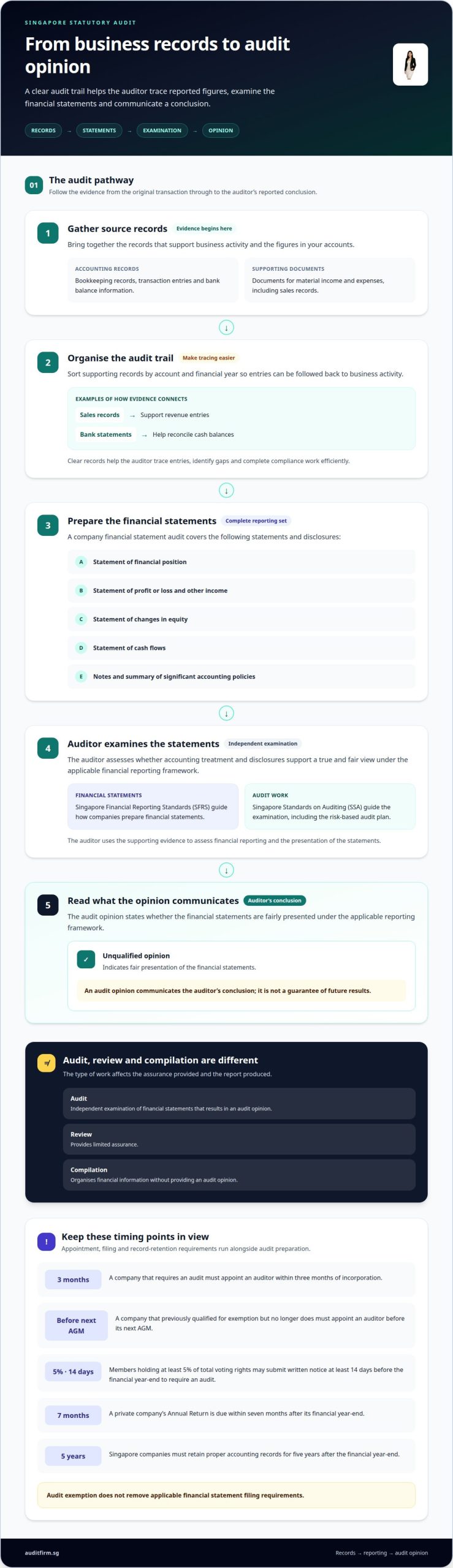
Prepare accounting records and financial statements that let the auditor trace reported figures to business activity. These typically include bank balance information, bookkeeping records, transaction entries, and supporting documents for material income and expenses. For example, sales records should support revenue entries, while bank statements help reconcile cash balances. The auditor uses this evidence to assess financial reporting and whether the statements present a true and fair view.
A company financial statement audit covers the statement of financial position, statement of profit or loss and other income, statement of changes in equity, statement of cash flows, notes, and a summary of significant accounting policies. Organise supporting records by account and financial year. Clear records help the auditor trace entries, identify gaps, and complete compliance work efficiently. For more detail, see how to prepare for a statutory audit.
The Companies Act provides exemptions, but eligibility depends on the company’s status and activity. According to Singapore Statutes Online, Section 205B exempts a dormant company from audit requirements, and this exemption is not limited to private companies. A dormant company generally has no accounting transactions during the financial year, apart from transactions permitted under the Act.
A private company may qualify for the small-company audit exemption in Singapore if it meets at least two of three criteria for the immediate past two consecutive financial years: annual revenue of S$10 million or less, total assets of S$10 million or less, and 50 or fewer employees. Corporate shareholders do not automatically prevent qualification. For a company in a group, the company and group must meet the relevant small-company and small-group tests. The group test uses consolidated figures and at least two of three criteria.
A statutory audit is an independent examination of financial statements that results in an audit opinion. A review provides limited assurance, while a compilation organises financial information without providing an audit opinion. Audit effort depends on the company’s scale and the clarity of its accounting records, so complete schedules and traceable entries help the work proceed efficiently.
Audit opinions and Singapore Financial Reporting Standards
Singapore Financial Reporting Standards (SFRS) guide how companies prepare financial statements, while audit standards guide how auditors examine them. The audit opinion sets out the auditor’s conclusion and helps readers understand the statements.
Audit Opinions and Reporting Standards
An audit opinion states whether financial statements are fairly presented under the applicable financial reporting framework. An unqualified opinion indicates fair presentation. Singapore’s SFRS are based on International Financial Reporting Standards, while SFRS for Small Entities are based on IFRS for SMEs. The opinion matters to shareholders and other users because it communicates the auditor’s conclusion, not a guarantee of future results.
Annual Financial Statement Audits
An annual financial statement audit examines statements prepared for a company’s financial year against the applicable SFRS. The auditor assesses whether the accounting treatment and disclosures support a true and fair view. This reporting basis helps shareholders understand performance, financial position, and cash flows. The Singapore Standards on Auditing (SSA) guide the audit work, including the risk-based audit plan.
Audit exemption does not remove financial statement filing requirements. Companies must still meet their applicable filing obligations, even when exempt from an audit. Singapore companies must also retain proper accounting records for five years after the financial year-end. A private company’s Annual Return is due within seven months after its financial year-end.
Group reporting needs a separate view. SFRS 110 defines a group as a parent and its subsidiaries. Consolidated statements present the group as a single reporting entity, so the assessment considers group figures rather than only the parent’s standalone accounts. For audit exemption, group membership follows the Accounting Standards, and the group test uses consolidated financial information.
Clear reporting helps your auditor assess the statements and explain the opinion. For support with Singapore statutory audit requirements, keep the financial year records and reporting framework aligned.
Auditor appointment requirements
Companies that require an audit must appoint an auditor and meet filing deadlines. An audit exemption removes the audit requirement, not the obligation to file financial statements.
Appointing an Auditor
Auditor appointment is the formal step of engaging an auditor to examine a company’s financial statements. A company that requires a statutory audit must appoint an auditor within three months of incorporation. The auditor needs time to review records before reporting. A company that previously qualified for exemption but no longer does must appoint an auditor before its next AGM.
Shareholders also have a route to require an audit. Members holding at least 5% of a company’s total voting rights can submit written notice at least 14 days before the financial year-end. This right gives qualifying shareholders a way to request an audit even when the company would otherwise rely on an exemption. The company’s assessment should consider its status and applicable criteria for each relevant financial year.
Appointment and Filing Deadlines
Appointment and filing deadlines set the timetable for audit work and annual compliance. A statutory audit usually takes place after the financial year-end and before the AGM. Private companies must file their Annual Return within seven months after the financial year-end. Allow enough time for the auditor to examine the statements before the filing deadline.
A company and each director in default may each face a fine of up to S$5,000 for failing to appoint an auditor on time. Late annual returns may attract penalties of up to S$600. These are distinct compliance failures, so missing an appointment deadline and filing late can have separate consequences.
If directors fail to appoint an auditor, any company member may apply to ACRA to make the appointment. The Registrar may also require audited financial statements. Align the company’s financial year-end, AGM timetable, and Annual Return due date so the audit can be completed before filing. Companies that qualify for audit exemption must still meet their financial statement filing requirements.
What deadlines apply to appointing an auditor and filing audited financial statements with ACRA?
For a Singapore company that requires an audit, the timeline runs from incorporation through the financial year-end, audit, and annual filing. Aligning these dates gives the auditor time to examine the statements before the company’s reporting obligations fall due.
A company that requires a statutory audit must appoint an auditor within three months of incorporation. The audit typically takes place after the financial year-end and before the AGM. This sequence gives the auditor access to the completed year’s records and time for the company to prepare audited statements for its reporting process.
The Annual Return deadline depends on the company’s AGM arrangements. A private company must file its Annual Return within seven months after its financial year-end. If the company holds an AGM, it must submit the Annual Return within one month after the meeting. A company that does not require an AGM must file no later than seven months after year-end.
A private company may waive its AGM if it circulates its financial statements to shareholders within five months after the financial year-end. If it holds an AGM, the meeting must take place once every calendar year or within six months of the financial year-end, as applicable. These dates affect when directors and the auditor need the statements ready.
Keep the appointment, audit, AGM, circulation, and ACRA filing dates on one reporting calendar. ACRA must be notified within 14 days after an auditor’s appointment or a change in appointment. An auditor’s resignation also affects the timetable: the company must hold a general meeting within three months of receiving the resignation notice to appoint a replacement.
Late filing can lead to penalties of up to S$600 for annual returns. Failing to appoint an auditor on time can expose the company and each director in default to fines of up to S$5,000. Set the audit timetable early to reduce deadline pressure. Arrange statutory audit support to keep the review and reporting process moving.
Auditfirm.sg: Statutory Audit
Auditfirm.sg provides statutory audit support for Singapore companies that need an independent review of their financial statements. Its qualified auditors help you prepare for the audit, review accounting records, and complete the work professionally and in line with reporting deadlines.
Turn to Auditfirm.sg when your company does not qualify for an audit exemption, an exemption no longer applies, or you need an audit for group reporting. The firm also provides Clubs, Association & Societies Audit and Non-Profit Audit services in Singapore for charities for organisations with those reporting needs. Clear records and timely coordination help the audit proceed smoothly.
If you need help with an upcoming audit, contact Auditfirm.sg to discuss your requirements.
Build stronger oversight into your next reporting cycle
Use the next audit cycle to make financial oversight part of routine management. Clearly assigned follow-up actions and well-documented decisions help directors track issues after the audit report is issued. Reviewing whether internal controls still reflect current operations also keeps governance practical as the business changes.
A statutory audit in Singapore can support this wider view of compliance. Auditfirm.sg provides Statutory Audit, Group Audit, and Clubs, Association & Societies Audit. Its qualified auditors help businesses complete audit work professionally and meet reporting deadlines. Suitable audit support can clarify directors’ responsibilities and provide an orderly basis for the next reporting cycle.
When you’re ready to discuss your audit needs, contact Auditfirm.sg about your audit. Take the next step with a clear plan for your company’s reporting and governance.
Frequently Asked Questions
Can companies with corporate shareholders get audit exemption?
Yes. Corporate shareholders do not automatically prevent a Singapore private company from qualifying for the small-company audit exemption. The company must still meet the applicable criteria and remain private for the relevant financial year. If it has a corporate parent, assess whether group-related exemption rules also apply. Ownership alone does not determine eligibility; the company’s status and financial results matter.
Does your company need an audit?
Your company needs an audit if it is subject to the statutory requirement and does not qualify for an exemption. The answer can change when the company’s status or financial results change. For example, a company that previously qualified for an exemption may need to appoint an auditor if it later stops meeting the criteria. Directors should include this assessment in the company’s reporting plans. To assess eligibility and prepare, see how to prepare for a statutory audit and check if you need one.
What determines the audit requirements for a Singapore company?
The applicable requirements depend on the company’s status, financial results, and any relevant group structure. Shareholders can also require an audit by giving written notice under the applicable rules. This may matter when members want an independent examination despite the company’s exemption position. Keep ownership and financial information current so the audit assessment reflects the right reporting period.
What should you look for when choosing a reliable Singapore audit firm?
Choose an audit firm with ACRA-registered auditors and experience relevant to your organisation. Before work begins, clarify the engagement scope, information requests, and reporting timetable. A group, charity, or association may have different reporting needs from a private trading company. A suitable fit keeps communication focused on the records and issues relevant to your organisation.
How do statutory audit services support compliance?
Auditors examine financial statements and supporting evidence, then report their findings in an audit opinion. For example, they may trace a reported transaction to its source documents and assess its accounting treatment. This independent review can help directors identify matters requiring attention. The audit supports compliance, while the company’s directors remain responsible for its financial statements and accounting records.
Can a dormant company be exempt from an audit?
Yes. Section 205B of Singapore’s Companies Act exempts a dormant company from audit requirements, and the exemption is not limited to private companies. Dormancy generally concerns whether the company had accounting transactions during the financial year, subject to transactions permitted under the Act. This audit exemption does not by itself remove other applicable company reporting obligations.