
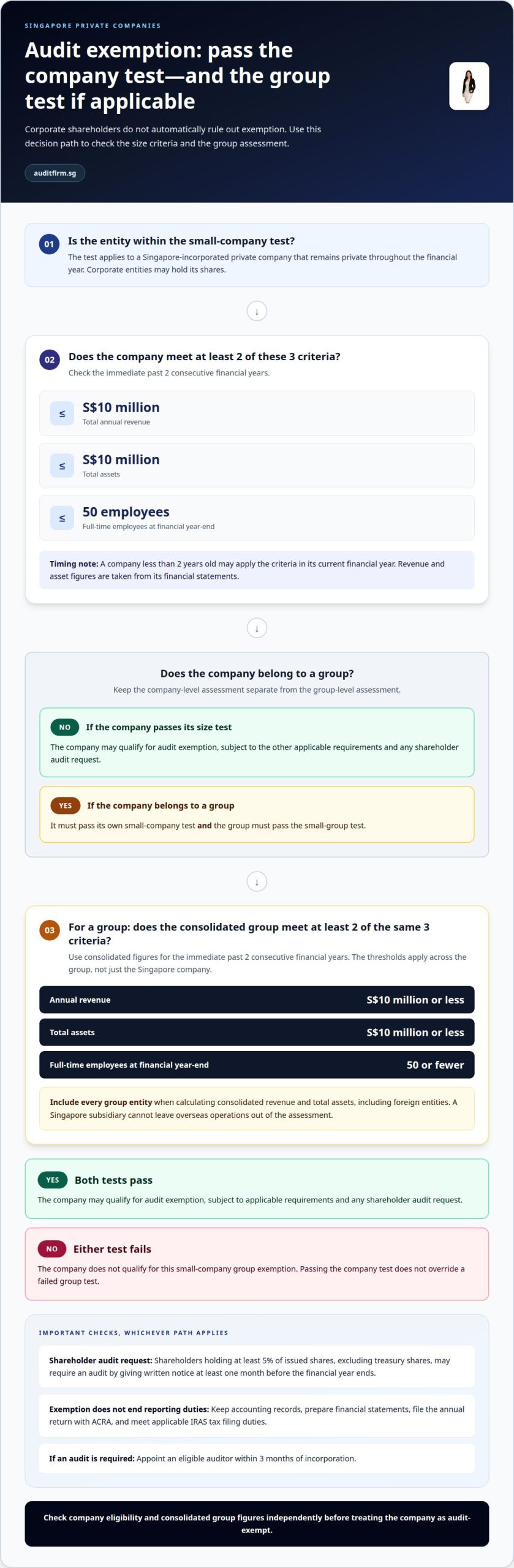
A Singapore-incorporated private company can qualify for audit exemption in Singapore even if it has corporate shareholders, provided it meets at least two small-company criteria. If it belongs to a group, both the company and the group must meet the relevant tests, with the group assessed using consolidated figures that include foreign entities. Exemption removes the statutory audit requirement, but the company must still keep accounting records, prepare and file financial statements and annual returns, and meet applicable tax filing duties.
Key Takeaways
- Corporate shareholders do not automatically prevent a private company from qualifying; focus on whether it meets the small-company criteria.
- If your company belongs to a group, assess both the company’s own eligibility and the group’s consolidated figures, including foreign entities.
- Audit exemption does not remove your duties to keep accounting records, prepare financial statements and meet applicable filing obligations.
- If an audit is required, the right audit service depends on your company’s structure and type, including whether it is part of a group or a non-profit.
Can companies with corporate shareholders get audit exemption?
Yes. A Singapore private company can qualify for audit exemption even when corporate entities hold its shares. It does not have to be an exempt private company. The small-company test applies only to Singapore-incorporated private companies, and the company must remain private throughout the financial year.
For the immediate past two consecutive financial years, the company must meet at least two of three size criteria: total annual revenue of S$10 million or less, total assets of S$10 million or less, or no more than 50 full-time employees at financial year-end. The revenue and asset figures come from its financial statements. A company less than two years old may apply the criteria in its current financial year.
The framework applies to financial years beginning on or after 1 July 2015. A company incorporated before 1 July 2015 could qualify under transitional provisions by meeting the criteria in either its first or second financial year after commencement.
A dormant company has a separate exemption. According to Singapore Statutes Online, Attorney-General’s Chambers, a dormant company in Singapore is exempt from the statutory audit requirement under Section 205B of the Companies Act. Section 205B(3) identifies specified matters that are not treated as accounting transactions when determining dormancy. Corporate shareholders can also retain a say: shareholders holding at least 5% of issued shares, excluding treasury shares, may require an audit by giving written notice at least one month before the financial year ends.
If a company requires a statutory audit, it must appoint an eligible auditor within three months of incorporation.
Small group audit exemption
For audit exemption in Singapore, a company in a group must pass two assessments. The company must qualify as a small company itself, and the entire group must meet the small-group test. That group test uses consolidated figures for the immediate past two consecutive financial years.
On a consolidated basis, the group must meet at least two of three criteria: annual revenue of S$10 million or less, total assets of S$10 million or less, or no more than 50 full-time employees at financial year-end. The thresholds apply across the group, not only to the Singapore entity seeking exemption.
Include every group entity, including foreign entities, when calculating consolidated revenue and total assets. A Singapore subsidiary cannot leave overseas operations out because those companies are incorporated elsewhere. Under paragraph 12(a) of the Thirteenth Schedule to the Companies Act, Accounting Standards determine whether an entity belongs to a group.
A parent’s reporting arrangements do not remove the test. A Singapore company owned by another company must assess whether it belongs to a small group, even if it does not prepare or file consolidated financial statements. For example, a subsidiary may meet its own small-company test but fail the group test if the combined group misses at least two criteria.
Keep the company-level and group-level assessments separate. Passing the first does not override the second. Review the consolidated figures for each of the two consecutive financial years before treating the company as exempt from audit requirements. This distinction matters for audit exemption in Singapore, even when the local company has limited operations but belongs to a larger overseas group.
Who Qualifies for Audit Exemption in Singapore?
Audit exemption does not prevent regulatory scrutiny or remove the need to support company reporting. Your company’s records and filings must remain accurate and complete.
Financial and Employee Thresholds
The size test is only one part of deciding whether an audit is required. A company should also keep accounting records that support its reported figures, including revenue, assets and employee information. These records show how the financial statement figures were prepared and provide a basis for responding if the Registrar questions compliance.
Keep evidence for each financial year rather than relying only on summaries prepared for filing. Clear supporting records help show how reported amounts were derived.
Different Rules for Company Types
A subsidiary’s position depends on its group assessment. Public companies, including those listed on the Singapore Exchange, remain subject to statutory audit requirements regardless of size. Foreign companies and Singapore-registered branches may have to lodge audited financial statements with ACRA, subject to applicable requirements and exemptions. These distinctions matter because a private-company exemption does not automatically extend to every entity operating in Singapore.
Even an exempt company must prepare financial statements under prescribed accounting standards and file its annual return with ACRA. The return includes unaudited financial statements in the applicable XBRL format. Exemption is assessed at each financial year-end and declared through that filing; no prior ACRA approval is required.
The Registrar may require an audit-exempt company to lodge audited financial statements and an auditor’s report if it is satisfied that the company breached section 199 or section 201 of the Companies Act. Audit exemption therefore does not shield a company from an audit order when statutory accounting or reporting requirements have been breached.
A company and each director in default may each face a fine of up to S$5,000 for failing to appoint an auditor on time. A company that loses its exemption must appoint an auditor before its next AGM. Exempt companies must also meet applicable IRAS tax filing duties.
Audit exemption obligations
Audit exemption changes the statutory audit position, not the company’s tax responsibilities. Keep the distinction clear when planning year-end compliance: IRAS filing duties apply separately, and the company’s tax position determines which submissions are required. An audit-exempt company still needs to meet applicable Estimated Chargeable Income (ECI) and Corporate Income Tax Return requirements.
For companies generally required to file ECI, the filing deadline is within three months after the financial year-end. For example, a company with a 31 December year-end generally files its ECI within the following three months. A company is exempt from filing ECI if its annual revenue is S$5 million or less and its ECI is nil.
The Corporate Income Tax Return generally has a different deadline: 30 November each year. Keep that date in view even if the company qualifies for audit exemption or does not need to file ECI. The ECI filing exemption does not itself remove the separate tax-return obligation.
Include these dates in the company’s compliance calendar alongside its financial year-end. Identify whether ECI is required, whether the nil-ECI exemption applies, and which Corporate Income Tax Return is due. Separating audit status from tax filing status helps prevent one exemption from being mistaken for another. The key takeaway is simple: audit exemption does not, on its own, settle the company’s IRAS filing duties.
Auditfirm.sg
If your review shows an audit is required, or your company needs help completing audit work, Auditfirm.sg provides audit services suited to different entities and reporting structures. If your company qualifies for exemption and has no other audit requirement, an audit service may not be necessary.
For a company with a statutory audit requirement, Auditfirm.sg’s Statutory Audit service examines its financial statements. An audit is relevant when your company must meet statutory audit requirements, not simply because it has corporate shareholders or belongs to a group.
Group Audit can support companies whose reporting involves related entities. The group structure can affect the audit work and the information needed across entities. This is distinct from deciding whether the small-group exemption criteria are met: an exemption assessment and an audit engagement address different needs.
Auditfirm.sg’s Clubs, Association & Societies Audit and Non-Profit Audit services are designed for organisations with those structures. Their reporting context differs from that of a standard private company. Choosing a service that matches the organisation helps keep the audit scope relevant to its financial statements and governance needs.
If your company needs an audit, prepare its financial statements and accounting records for the engagement. Clear records help the audit address relevant transactions and the reporting period. An audit does not replace your company’s continuing filing, accounting or tax obligations.
Apply the eligibility rules first, then consider the audit work your organisation actually needs. Auditfirm.sg provides audit services for companies, groups, clubs, associations and non-profit organisations. Its auditors are ACRA-registered and have experience auditing these entities. If the company remains exempt and has no separate reason for an audit, focus on its ongoing financial reporting and filing duties.
Contact Auditfirm.sg to discuss your audit requirements.
Frequently Asked Questions
What about newly incorporated companies?
A Singapore company less than two years old may qualify by meeting the small-company criteria in its current financial year. This lets a newly formed private company assess eligibility before it has two completed financial years. Keep accounting records from the start of operations so its first-year revenue, assets and employee count can be assessed accurately.
What are the audit exemption criteria for Singapore companies?
A Singapore-incorporated private company must meet at least two of three size criteria for the relevant financial years. If it belongs to a group, it must also pass the group-level test. These are separate assessments: meeting the company-level criteria does not establish that the consolidated group qualifies. Public companies cannot use the small-company exemption, regardless of size.
What are Singapore’s small company thresholds for audit exemption?
The thresholds are annual revenue of S$10 million or less, total assets of S$10 million or less, and no more than 50 full-time employees at financial year-end. The company must meet at least two criteria. Revenue and assets are assessed using amounts shown in its financial statements, while the employee count is based on the year-end position.
Which Singapore companies must have their financial statements audited?
Public companies, including companies listed on the Singapore Exchange, are subject to statutory audit requirements regardless of size. A private company that does not qualify for an exemption must also have an audit. Foreign companies and Singapore-registered branches may need to lodge audited financial statements, subject to applicable requirements and exemptions. Shareholders may also require an audit under applicable notice rules.
Are dormant companies exempt from audit in Singapore, and what are the conditions?
Yes. A dormant company is exempt from the statutory audit requirement under Section 205B of the Companies Act, according to Singapore Statutes Online, Attorney-General’s Chambers. The dormancy exemption covers a company dormant since formation or since the end of its previous financial year. Section 205B(3) excludes specified matters from accounting transactions when determining whether a company is dormant.
How do private companies apply for or qualify for audit exemption with ACRA?
A private company does not need prior ACRA approval or a separate application to claim the small-company exemption. It assesses eligibility at each financial year-end, then declares its audit status through its annual return filing. Keep the underlying financial statements and accounting records ready to support that assessment. If the company fails the criteria, it must arrange an audit as required.