
Publicly listed firms in Singapore must complete annual statutory audits, while a private company may qualify for exemption if it meets at least two of three criteria for two consecutive financial years: annual revenue of no more than S$10 million, total assets of no more than S$10 million, or no more than 50 employees. Knowing how to prepare for a statutory audit starts with understanding which rules apply to your company.
It’s understandable to focus on deadlines, but accurate, organised records matter just as much. Gaps in reconciliations or missing transaction support can make an audit harder to manage. Prepare early so your auditor can review the financial statements and you can respond to questions promptly.
This guide explains how to assess whether your company needs an audit and how to prepare for statutory audit work in Singapore. You’ll learn which records to organise, how to coordinate with your auditor and how to keep compliance tasks on track.
Key Takeaways
- Assess whether your private company meets at least two of the small-company criteria for two consecutive financial years to determine if it may qualify for audit exemption.
- Prepare draft financial statements and reconcile bank accounts, receivables, payables and equipment records before audit fieldwork begins.
- Agree the audit timetable, key contacts and document-transfer method with your auditor so your team can respond to requests promptly.
- Organise supporting records, including ledgers, bank statements, invoices, receipts and tax documents, and address outstanding findings from previous audits.
Do all companies in Singapore need a statutory audit?
Publicly listed Singapore firms need annual statutory audits. A private company may qualify for exemption if it meets at least two of three criteria for two consecutive financial years: annual revenue of no more than S$10 million, total assets of no more than S$10 million, or no more than 50 employees.
Prepare statutory financial statements under Singapore Financial Reporting Standards (SFRS) or other applicable standards. Singapore Standards on Auditing (SSA) guide the audit work.
Missing audit deadlines can lead to composition fines of up to S$5,000 per charge. Failure to hold an AGM or present audited accounts can result in a S$500 composition fine per breach.
Choose an auditor based on relevant audit experience, scope, timetable and communication arrangements. A Singapore company must appoint an auditor within 3 months of incorporation unless it is audit-exempt; plan well before year-end.
- Prepare draft accounts for the financial year, including a profit and loss statement, balance sheet and supporting financial statements. Keep the figures consistent with the accounting records.
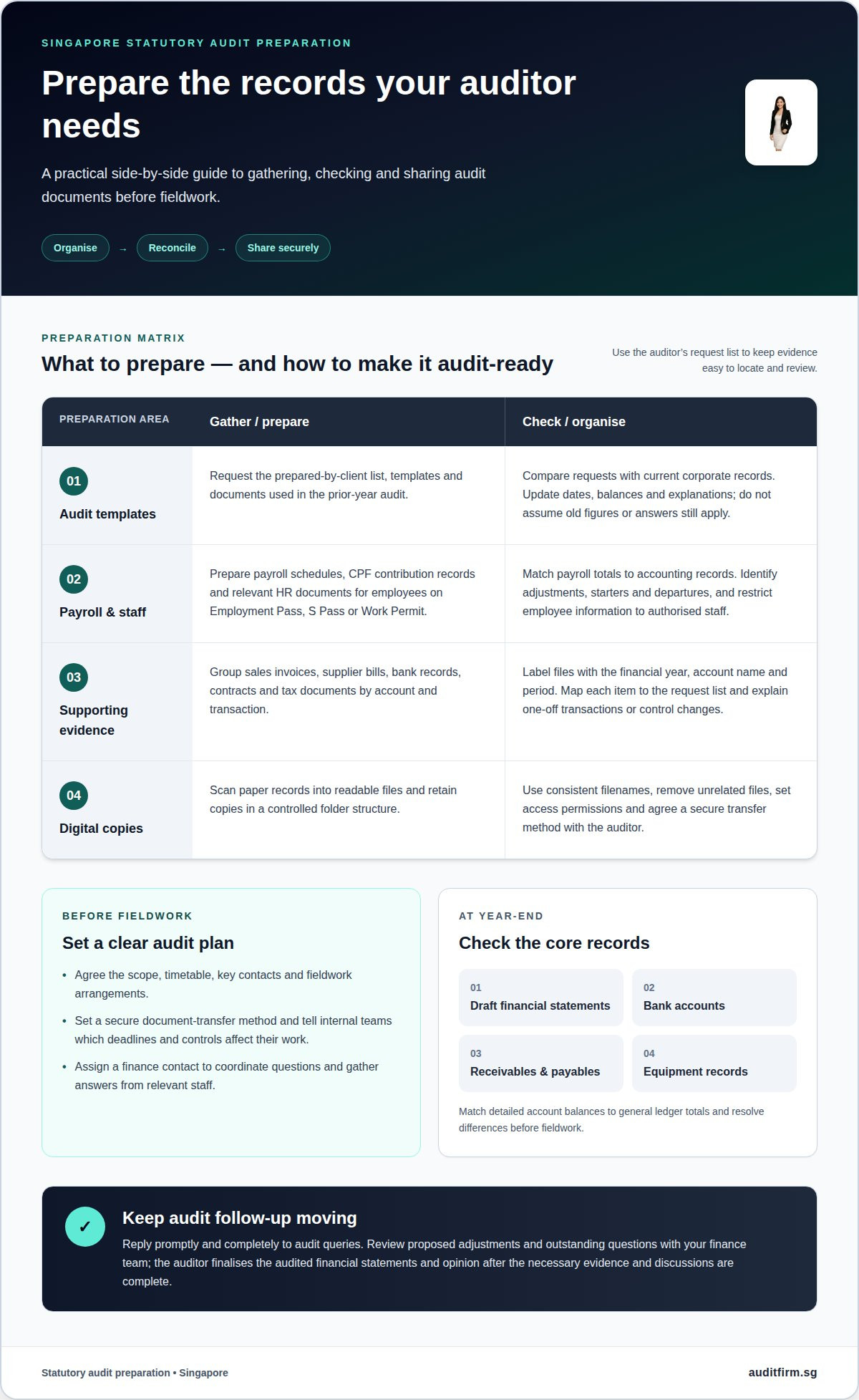
- Reconcile bank accounts, accounts receivable, accounts payable and equipment lists. Match detailed account balances to general ledger totals and resolve differences before fieldwork.
- Provide accounting records such as general ledgers, bank statements, invoices, receipts and tax documents. Include supporting papers for significant or unusual transactions.
- Brief your auditor on unusual transactions, new projects, investments and changes to controls. Share contracts and explain the business purpose so the auditor can assess the accounting treatment.
- Arrange secure access to your online accounting software and relevant financial data. Agree the access method and document-transfer process with the auditor before fieldwork.
- Assign a finance contact to coordinate audit queries and gather answers from relevant staff. Prompt, complete replies help the auditor resolve issues and progress the review.
- Review the auditor’s proposed adjustments and outstanding queries with your finance team. Once the necessary evidence and discussions are complete, the auditor finalises the audited financial statements and opinion.
What Are Some Audit Preparation and Planning Tips?
Before the annual audit begins, agree the scope, timetable, key contacts and fieldwork arrangements with your auditor. Set a secure document-transfer method and tell internal teams which reporting deadlines and controls affect their work. This gives everyone a clear plan for statutory audit fieldwork.
-
Request Audit Templates and Gather Prior-Year Documents for Your Auditor
Ask your auditor for the prepared-by-client list, templates and documents used in the prior-year audit. These show the expected format for schedules and supporting evidence. Compare each request with current corporate records, noting changes to transactions or reporting systems. Don’t reuse old figures or assume previous answers still apply: update dates, balances and explanations for the current financial year.
-
Provide Payroll and Employee Compliance Documents
Provide payroll schedules, CPF contribution records and relevant HR documents for employees on Employment Pass, S Pass or Work Permit. Match payroll totals to accounting records and identify adjustments, starters or departures. Include records that explain CPF and Employment Act compliance. Restrict employee information to authorised staff and share only files requested for the audit.
-
Organise Supporting Documents for Your Auditor
Group supporting documents by account and transaction, including sales invoices, supplier bills, bank records, contracts and tax documents. Label each file with the financial year, account name and period, then map it to the auditor’s request list. Explain one-off transactions and changes to internal controls. A clear index helps your finance team locate evidence and avoid duplicate requests.
-
Keep Digital Copies of Documents Requested for the Audit
Scan paper records into readable files and retain copies in a controlled folder structure. Use consistent filenames, such as account, period and document type, so your team can identify current versions quickly. Before sharing, remove unrelated files and set access permissions. Agree how the auditor will receive files securely, who can view them, and how queries will flag missing pages or errors, since these arrangements support statutory audit support. Keeping copies and tracking requests clarifies how to prepare for statutory audit follow-up.
Audit compliance and record-keeping
Keep accounting records complete and available to the audit team throughout the financial year, not just at year end. In Singapore, statutory audit timing aligns with the company’s financial year end and annual general meeting schedule.
-
Plan for Audit and Annual Filing Deadlines with Your Auditor
Agree the audit timetable with your auditor and map fieldwork against your financial year end and AGM schedule. File the Annual Return through ACRA BizFile+ and tax filings through IRAS myTax Portal. An Annual Return filed up to 3 months late incurs a S$300 fine; more than 3 months late incurs a S$600 fine. Audit deadline failures can lead to composition fines of up to S$5,000 per charge.
Set internal milestones for draft accounts, evidence requests and management responses. Share the schedule with the audit team and staff responsible for financial reporting. Incomplete records or complicated transactions can extend the audit, so raise delays early. This gives the team time to adjust fieldwork and keeps filing tasks visible.
-
Provide and Retain Records for Audit Compliance
Maintain the general ledger, bank statements, invoices, receipts, financial statements and tax documents for the period under audit. Provide records supporting ledger balances, including source documents for sales, purchases, assets and liabilities. Keep explanations alongside entries that need context, such as corrections or unusual transactions.
Use a record index to connect each account balance to its supporting evidence. Reconcile detailed account schedules to ledger totals and investigate differences before submitting them. Keep prior audit findings and responses with current compliance records. This helps the audit team trace how earlier issues were addressed and identify changes to internal controls.
- Assign an internal owner to each record category, such as bank reconciliations, sales documents or tax filings. That person can track requests, identify missing evidence and respond to audit queries. Record when each file is submitted and note any follow-up required.
Statutory audit process steps in Singapore
A Singapore statutory audit typically moves from planning and evidence review to audit queries, final statements and the auditor’s opinion. Agree the timetable with your auditor, as the work depends on your financial year end and the records available.
- Agree the audit scope and schedule. Share your financial year end, reporting requirements and key business changes. The auditor can prepare an audit planning report outlining the approach, timetable and significant risks discussed with management. Set dates for record requests, fieldwork and review of draft statements.
- Prepare for fieldwork. Provide requested accounting records and make relevant finance staff available to answer questions. The auditor tests selected transactions and balances, then follows up where evidence is incomplete or figures differ. Keep a contact person available to coordinate responses.
- Support review of significant matters. Explain unusual transactions, major acquisitions or disposals, and changes to business processes or controls. Share contracts and relevant calculations so the auditor can assess their accounting treatment and financial statement disclosures.
- Respond to audit queries. Assign each query to a staff member with access to the supporting records. Give clear answers with evidence, such as an invoice, agreement or reconciliation. If an amount needs correction, discuss the proposed adjustment and its effect on the statements.
- Review the draft financial statements. Check that company details, account balances and disclosures reflect the records provided. Discuss outstanding adjustments and questions with the auditor. The audit examines whether the statements give a true and fair view of the company’s financial position.
- Complete the audit and receive the report. The auditor finalises the audited financial statements and independent opinion after resolving relevant queries and completing review work. A Singapore statutory audit can take 4-8 weeks, depending on transaction complexity. Keep the agreed timetable aligned with your filing and AGM schedule.
For support with audit planning and completion, arrange your statutory audit.
Auditfirm.sg: Statutory Audit
Auditfirm.sg provides statutory audit support for Singapore companies that need an independent review of their financial statements. Engage the firm if your company is not audit-exempt, needs to meet statutory requirements or wants professional support coordinating audit queries and finalising audited accounts.
Auditfirm.sg’s auditors work with your finance team on records, transaction explanations and the audit timetable. The firm also handles Group Audit, Non-Profit Audit, and Clubs, Association & Societies Audit for organisations with those requirements. ACRA-registered auditors conduct the work, with attention to accurate reporting and timely completion.
Prepare your financial year details, draft statements and available accounting records for an initial discussion. Contact Auditfirm.sg to discuss your statutory audit requirements.
Make the Next Audit Cycle Easier to Manage
Treat the audit as a recurring governance routine, not just a year-end task. Preparing for a statutory audit also means considering how its findings can inform the next reporting cycle. Assign responsibility for agreed follow-up actions and include them in management reviews. Use the post-audit review to identify recurring delays, unclear ownership or accounting processes to address before the next close.
Auditfirm.sg provides Statutory Audit, Clubs, Association & Societies Audit and Group Audit. Its audit team supports businesses through the review and completion of audit requirements. A clear plan for acting on findings helps your team carry improvements into future reporting periods.
Contact Auditfirm.sg about audit support to discuss your upcoming audit and decide on a practical next step. With a defined plan, you can move forward with greater clarity.
Frequently Asked Questions
What documents will the auditor typically request?
Your auditor will typically request financial statements, general ledgers, bank statements, invoices, receipts and tax documents. Depending on your company’s transactions, prepare supporting items such as signed customer or supplier agreements, loan documents, fixed-asset schedules and board records approving major decisions. Link each document to the relevant account or transaction so the audit team can trace how a reported figure was recorded and supported.
Why is Proper Audit Preparation Important?
Good preparation gives the auditor a clearer basis for testing reported figures and helps your finance team answer questions without searching through scattered files. For example, matching a sales invoice to its ledger entry and payment record makes the transaction easier to trace. Preparation can also reveal unexplained differences or missing evidence early, giving management time to investigate before fieldwork.
What is a statutory audit in Singapore and which companies must have one?
A statutory audit is an independent examination of a company’s financial statements, resulting in an auditor’s opinion. Singapore companies generally need an annual audit unless an applicable exemption applies. A private company may qualify as a small company if it meets at least two of these criteria for two consecutive financial years: annual revenue up to S$10 million, total assets up to S$10 million, or no more than 50 employees.
What documents and records should a Singapore company provide to its statutory auditor?
Provide records that explain the financial statements and key balances for the audit period. These commonly include accounting ledgers, bank records, sales and purchase evidence, tax documents, and schedules for assets and liabilities. If a figure relates to a specific agreement or decision, include the supporting document. For example, loan records should explain the terms, movements and year-end balance.
How can an auditor help prepare a company’s financial statements for a Singapore statutory audit?
An auditor independently examines the company’s financial statements and may ask about accounting policies, estimates, disclosures or unusual transactions. The auditor can discuss proposed adjustments and explain what supporting evidence is needed. Management remains responsible for the statements and information provided. For example, the auditor may ask management to explain the basis for an asset valuation before assessing how it is presented in the accounts.
What are common audit issues and how can a company avoid delays?
Incomplete records, unreconciled balances, accounting problems and complicated transactions can extend an audit. Reduce delays by investigating differences between account schedules and ledger totals before fieldwork, and keeping evidence for significant transactions together. Tell the audit team early about new or unusual transactions, including acquisitions or disposals. Assign staff to handle queries and support each response with clear documentation rather than unexplained figures.