
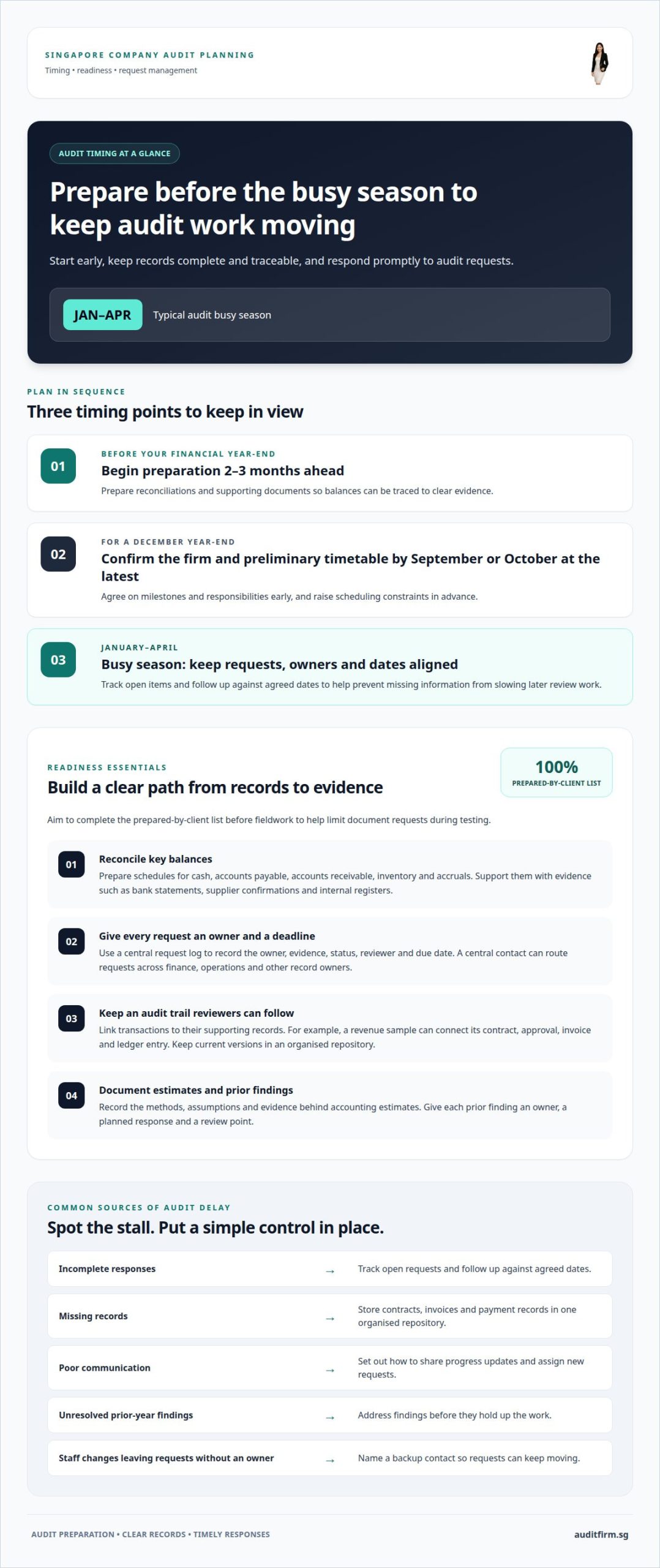
To avoid delays in company audit work in Singapore, prepare early, keep records complete and traceable, and respond promptly to audit requests. The audit busy season typically runs from January to April, so begin preparing 2–3 months before your financial year-end. For a December year-end, confirm the audit firm and preliminary timetable by September or October at the latest; this article explains how readiness, audit trails, common failures and seasonal timing affect audit progress.
Key Takeaways
- Prepare reconciliations and supporting documents so auditors can trace balances to clear evidence.
- Keep an organised audit trail and assign clear owners to requests to help prevent missing information and slow responses.
- Agree on audit milestones and responsibilities early, and address prior-year findings before they hold up the work.
- Understand how your organisation’s records, reporting needs and year-end schedule shape audit preparation.
1. What Is Audit Readiness and Why Does It Matter?
Audit readiness means providing complete, accurate information with a clear audit trail. Before fieldwork, management prepares reconciliations for cash, accounts payable, accounts receivable, inventory and accruals. Auditors review those schedules against independent evidence, such as bank statements, supplier confirmations and internal registers. They investigate differences and request explanations or corrections when balances do not agree. Aiming to complete 100% of the prepared-by-client list before fieldwork helps limit document requests during testing.
Preparation also depends on clear coordination across departments. Appoint a central contact to route requests to finance, operations and other record owners. For example, finance may provide a bank reconciliation while purchasing supplies the related invoice and contract. Agree on the documents needed and target dates, then track outstanding items. Clear communication helps prevent requests from landing with the wrong team or being answered with incomplete files.
Accounting estimates need supporting evidence, not just a figure in the ledger. Auditors review the methods, assumptions and evidence behind judgements such as impairment testing or revenue recognition. Management should document why it selected an assumption and how that assumption supports the recorded amount. If the rationale is missing, auditors may need further explanations or evidence before determining whether the estimate follows applicable standards.
A pre-audit review can identify gaps in financial reporting, internal controls and documentation before fieldwork begins. Review preliminary financial statements, sample reconciliations and prior findings, then record questions for management. Store current contracts, invoices and payment records in a central, organised repository so teams can retrieve them without searching separate folders. Dated, reviewed files make it easier to follow changes and trace balances to supporting evidence.
Control and systems documentation gives auditors context on how transactions move through your business. They may review who authorises payments, records transactions and performs reconciliations. Separating these duties can help reduce errors and improve accountability. Process notes, access records and evidence of controls help auditors understand whether procedures operate as described. Preparing this information early gives your team time to address missing records or unclear responsibilities before they interrupt audit work.
2. Audit readiness frameworks and audit trails
A practical readiness framework links each audit request to an owner, record and deadline. Track the request’s status, reviewer and evidence in one place. For example, a revenue sample can link to its contract, approval, invoice and ledger entry. This audit trail lets reviewers follow transactions from source records through to financial reporting. Keep records current, manage access and retain clear versions to protect the integrity of the file.
Plan staffing around how each department supports the audit. Map responsibilities across finance, operations and management, then assign evidence collection and review to the relevant people. A communication brief can set out the audit scope, objectives and timeline. If a key employee is unavailable, a prepared backup contact can keep requests moving. Clear ownership also makes unanswered requests easier to identify and escalate.
An audit readiness assessment reviews financial reporting, internal controls and documentation before fieldwork. Compare available records with the request list, inspect how evidence is stored, and note gaps in responsibilities or processes. These findings help management prioritise missing documents, unresolved control issues and outdated procedures. Update the checklist as tasks emerge to keep owners and deadlines aligned.
A pre-assessment review can test whether documented practices match actual operations. For example, an auditor may trace a sample purchase through approval, recording and review, then identify where evidence is missing. Internal audit work can assess whether procedures are followed, earlier issues are addressed and corrective actions work as intended. Give each finding an owner, a planned response and a review point.
Agree on how to share progress updates and assign new requests. A central request log can show open items, responsible staff and due dates, while version control helps teams use current records. This approach supports orderly coordination across departments and gives management a clear view of preparation progress before fieldwork begins.
3. What are the top reasons companies fail audits?
An agreed audit timeline sets milestones from interim testing through final reporting. Auditors discuss your year-end, transaction volume, reporting needs and staff availability before setting dates. They clarify who supplies records, reviews queries and approves draft statements. A shared checklist makes dependencies visible, such as completing schedules before sample testing begins. To avoid delays in company audit work, raise scheduling constraints early and agree on practical next steps.
When choosing an external auditor in Singapore, consider relevant audit experience, independence and your company’s reporting needs. Agree on the audit scope, communication arrangements and milestones, then document the appointment through your company’s governance process. Clearly allocate responsibilities so directors and finance staff understand what the engagement requires.
Singapore’s statutory audit exemption may apply to qualifying small companies, subject to statutory criteria. Group structure can affect eligibility, so assess your company’s circumstances against the applicable requirements before relying on an exemption. Confirming the audit requirement early helps management plan its reporting process appropriately.
Common causes of audit delays in Singapore include incomplete responses, missing records, poor communication and unresolved prior-year findings. Staff changes can also leave requests without an owner. For example, a transaction query may stall while finance waits for evidence from another department. Track open items, assign responsibility and follow up against agreed dates. Address unanswered requests before they affect later review work to avoid delays in company audit engagements.
Professional auditors support directors and finance teams by clarifying requests, coordinating responsibilities and communicating findings as work progresses. Status updates can show open requests, owners and outstanding actions. For certification work, align the certification body’s assessment scope, dates and document requests with company preparations. If a regulatory or reporting issue emerges, discuss its effect on the timeline and agree on the action needed to keep the audit moving.
4. Singapore audit busy season and December year-ends
Singapore’s audit busy season typically runs from January to April. For a December year-end, confirm your audit firm and preliminary timetable by September or October at the latest. Begin audit preparation 2–3 months before your financial year-end, so your organization can resolve incomplete schedules and missing evidence before fieldwork. Waiting until January can leave less room to address questions during a period when audit teams are managing multiple engagements.
Use the early planning period to agree on key dates, departmental responsibilities and the order of work. For example, finance can schedule year-end schedules while operations identifies records supporting significant transactions. The auditor can set milestones for document delivery, query responses and review of draft statements. Keep the timetable current as deadlines change, and flag dependencies early. A missing contract or delayed schedule can affect later review steps, not just the person responsible for that file.
Singapore filing dates also make timely audit completion important. For companies with a December 31 financial year-end, a non-listed company must file its annual return by July 31. A non-listed company must hold its AGM within 6 months of its financial year-end. For a listed company with a December 31 year-end, the AGM deadline is within 4 months, and the annual return deadline is within 5 months.
Late annual return filing attracts a S$300 penalty if filed within 3 months of the deadline, and S$600 if filed more than 3 months after the deadline. These amounts relate to annual returns, not a general penalty for late financial statement filing. Track the audit, approval and filing stages separately, so a delay in one stage is visible before it affects another. Keep supporting evidence organised and ensure the final statements and records are ready for the required process.
To plan around Singapore’s busy season and year-end deadlines, arrange your company audit with a clear timetable.
Auditfirm.sg
Auditfirm.sg helps Singapore businesses manage audit requirements through clear preparation, documentation and communication. Its auditors review financial records, explain evidence requests and coordinate work towards agreed deadlines. This support can be useful when your finance team needs help organising audit information or your company is preparing for a statutory audit. Auditfirm.sg also provides Group Audit and Non-Profit Audit services.
Turn to professional audit support when year-end preparation is falling behind, audit requests are difficult to coordinate, or your organisation needs an external audit. Auditfirm.sg’s ACRA-registered auditors can help you address the audit work with care and accuracy. Contact Auditfirm.sg to discuss your company audit.
Set Your Audit Preparation in Motion
Turn audit readiness into a planned piece of work, with priorities that fit your reporting needs and internal responsibilities. A focused discussion can identify where professional support would help, whether you need a statutory audit, an audit for a club, association or society, or group audit support. Auditfirm.sg’s qualified auditors work with businesses to manage these requirements and keep the audit process organised.
To avoid delays in company audit work, act before outstanding questions or document gaps become urgent. Set a clear starting point with your finance team and agree how audit requests will be managed. This gives your organisation a practical basis for moving forward without unnecessary steps.
Discuss audit readiness with Auditfirm.sg and take the next step with a clear plan.
Frequently Asked Questions
What Is Audit Readiness and Why Does It Matter?
Audit readiness means your records and explanations are prepared for an independent examination. It matters because auditors need to understand how reported balances relate to your business activities, accounting policies and decisions. For example, a clear note explaining a change in revenue treatment can help the auditor assess its effect. Readiness also gives directors a clearer view of unresolved reporting matters.
What Is the Audit Peak Period in Singapore?
Singapore’s peak audit period is the annual busy season, when audit engagements are concentrated. The practical priorities are securing suitable scheduling and ensuring key staff can support the work. Consider your financial year-end, reporting complexity and internal approval process when discussing timing. If your operations have seasonal demands, factor them into the proposed timetable.
What are the top reasons companies fail audits?
Audit issues can arise when accounting policies are applied inconsistently or transactions are recorded in the wrong period. For example, revenue recorded before the related performance obligations are met may need adjustment. Unrecorded accruals, expense misclassification and incorrect depreciation calculations can also prompt audit adjustments. These findings do not automatically mean the company has failed its audit, but they do require clear explanations and appropriate follow-up.
What should you prepare for professional auditors before an external audit?
Prepare a clear overview of your reporting structure, key accounting policies and significant changes during the financial period. Identify who can explain major transactions, estimates and unusual balances. If your company changed systems or processes, briefly describe the change so auditors can understand how the records were produced. This context helps them plan their review and direct questions to the right people.
What are the deadlines for filing annual returns and audited financial statements in Singapore?
Filing deadlines depend on your company’s financial year-end and whether it is listed or non-listed. The applicable timetable also distinguishes between annual return, AGM and financial statement requirements. Check each obligation against your company’s reporting status rather than treating audit completion as the only deadline. Build time for internal approval and filing preparation into your reporting calendar.
What documents should your company provide to professional auditors before an audit?
Along with accounting records, provide governance documents relevant to the financial period, such as board resolutions, shareholder agreements and records of related-party transactions. These help auditors understand approvals, ownership arrangements and transactions outside routine operations. For a major asset acquisition, include the agreement and supporting records explaining its business purpose and accounting treatment. Organise files by topic so their context is clear.