
An audit of a society in Singapore is required when its gross income or expenditure exceeds S$500,000 in a financial year, under section 4 of the Societies Regulations. Other factors, including the society’s legal structure, constitution and funding arrangements, can also affect whether an audit is needed, so income alone may not settle the question.
Preparing for a clubs and societies audit in Singapore can feel unclear when committee members need to organise records for events, donations, grants and other funds. This guide explains when an audit applies, how auditors review financial statements and supporting documents, and which records can help the process run smoothly.
Key Takeaways
- Assess your society’s legal structure, constitution and funding requirements to identify audit obligations beyond financial thresholds.
- After a fundraising appeal concludes, submit its audited statement of accounts to the Registry of Societies within 60 days, according to the Registry of Societies.
- Keep a clear trail from donations, grants and online transactions to supporting records and the funds’ intended use.
- Prepare financial statements, governance records and internal-control information early to support the audit and respond to queries efficiently.
Does a Society Need an Audit in Singapore?
For a registered society, the key threshold is gross income or expenditure exceeding S$500,000 in a financial year. Section 4 of Singapore’s Societies Regulations requires the society’s accounts to be audited by a qualified company auditor when it crosses that threshold. The legal structure, constitution and funding arrangements can also affect whether an audit is required.
Clubs and associations registered as societies follow society requirements, while an organisation registered as a company may also have relevant company obligations. Charities have additional financial reporting and governance requirements under the Charities Act. Cooperatives operate under a separate legal framework, so their audit duties depend on the applicable rules and governing documents. No single test applies to every organisation.
Fundraising creates a specific filing duty. According to the Registry of Societies, a society must submit an audited statement of accounts for a fundraising appeal within 60 days after the appeal concludes. A society with no monetary transactions, assets or liabilities during a financial year can submit a signed declaration with its Annual Return instead of a Statement of Accounts.
If a society misses an audit or filing deadline, it has not met its reporting obligation. This can also weaken transparency and accountability to members, who rely on annual statements to understand income, spending and fund balances. Any penalty depends on the applicable rules and circumstances.
To appoint or replace an auditor, follow the society’s constitution and record the decision in the meeting minutes. Where an audit is required, the appointed auditor must meet the applicable qualification requirement. Give members clear information about the appointment and the resulting statement.
A member resolution alone does not create an audit exemption. Apply only an exemption permitted under the relevant Singapore rules, and retain the required declaration and supporting accounting records.
How an Auditor Reviews Donations, Grants and Funds
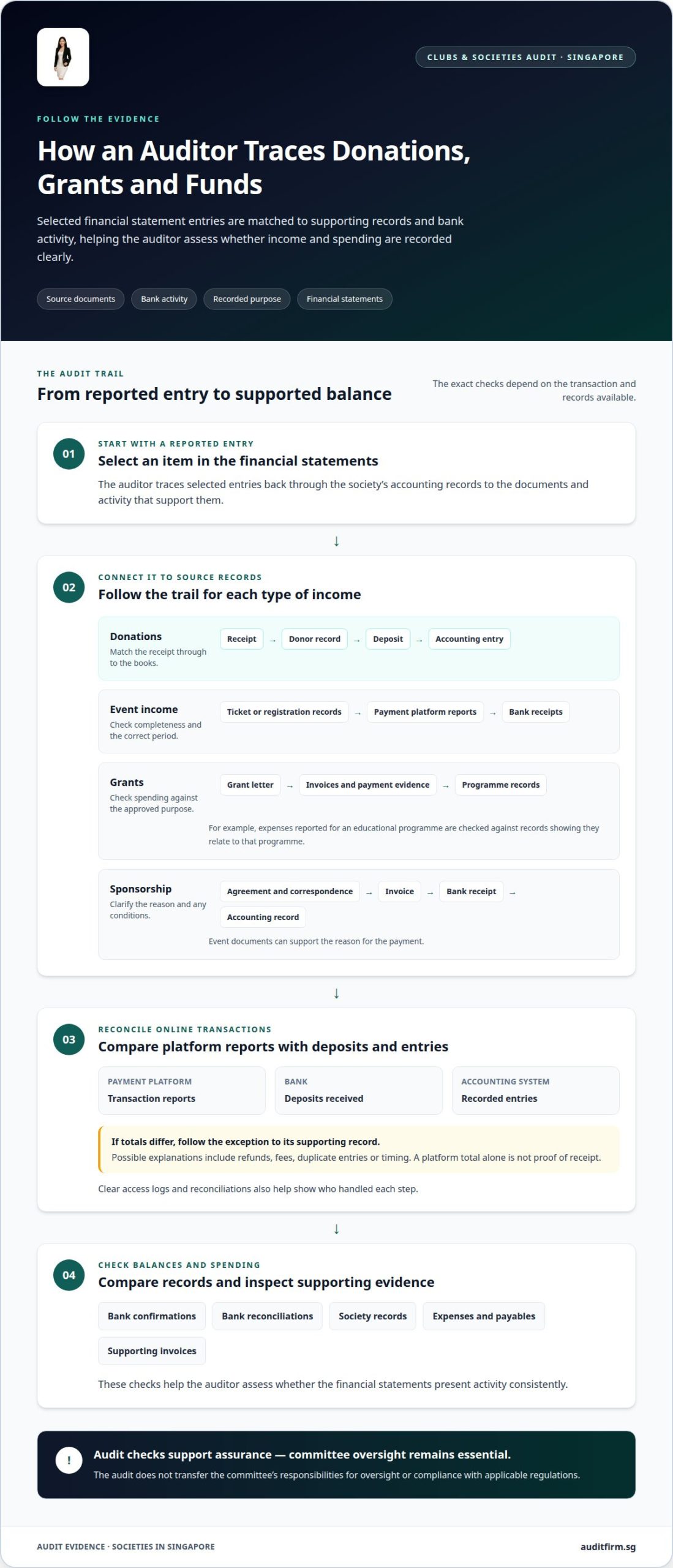
An auditor traces selected financial statement entries to supporting records and bank activity. For a donation, this may involve matching a receipt to a donor record, deposit and accounting entry. For event income, the auditor may compare ticket or registration records with payment platform reports and bank receipts. These procedures test whether income is recorded completely and in the correct period.
Grant reviews focus on the award terms, approved purpose and recorded spending. The auditor compares the grant letter with invoices, payment evidence and programme records. For example, if a grant funds an educational programme, the auditor checks whether reported expenses relate to that programme. This helps assess whether funds were used for their intended purposes and the association’s objectives.
Sponsorship income also needs a clear audit trail. The auditor may match a sponsorship agreement and sponsor correspondence with an invoice, bank receipt and accounting record. Event documents can support the reason for the payment. Retain these records so the auditor can see how each receipt was classified and whether any conditions apply.
For online transactions, the auditor may compare payment platform reports with bank deposits and accounting system entries. Differences can result from refunds, fees, duplicate entries or timing. The auditor follows exceptions through to supporting records, rather than treating a platform total alone as proof of receipt. Clear access logs and reconciliations also help show who handled each step.
Fund balances are reviewed against bank confirmations, reconciliations and the society’s records. The auditor may inspect expenses, payables and supporting invoices, then assess whether the financial statements present activity consistently. These checks provide assurance on reported information; they do not transfer the committee’s responsibilities for oversight or compliance with applicable regulations.
Audit Planning and Documents to Prepare for Your Auditor
Start planning before the financial year closes. Agree on the reporting period, expected statement format and audit timetable with the external auditor. Assign one committee contact to coordinate requests and track outstanding records. If committee members have changed, arrange a handover of accounting records, bank information, online banking access, prior financial statements and audit reports.
Prepare a clear set of records for the relevant period. Include:
- Trial balance, general ledger and draft financial statements.
- Bank statements, reconciliations and details of cash balances.
- Invoices, receipts, payment records and explanations for unusual entries.
- Membership, donation, sponsorship, grant and event income records.
- Asset schedules for items such as computers, furniture and sports equipment.
- Prior audited accounts and the previous auditor’s report.
Governance materials explain who approved decisions and why. Provide the society’s constitution, committee minutes, approved budgets and relevant grant agreements. Minutes can support decisions about major spending or restricted funds. Grant terms help the auditor assess whether reported expenditure matches the approved purpose.
Describe internal controls in practical terms. Explain who collects fees, approves payments, records transactions and reconciles bank accounts. If one person performs several duties, describe the review another committee member carries out. Provide recent bank reconciliations and evidence of approval for selected payments.
Use a request tracker to mark each item as ready, pending or not applicable. Keep files grouped by period and account, with clear names linking invoices to ledger entries. Registered societies must retain proper accounts and transaction records for at least 5 years. A consistent record trail helps the auditor follow balances and resolve queries efficiently.
How Often Must a Club or Society in Singapore Conduct an Audit and Submit Its Annual Returns?
For a registered society, plan around the annual reporting cycle. The society submits an Annual Return and audited statement of accounts each year. The audit period follows its financial year, while the filing deadline is linked to its Annual General Meeting (AGM).
After each AGM, submit the audited accounts with the Annual Return within one month. If no AGM is held, submit both within one month after the society’s financial year closes. Set the audit timetable around the AGM date or financial-year end, as applicable.
Keep the filing documents aligned. Under Regulation 7(1)(b) of the Societies Regulations, the Statement of Accounts submitted with the Annual Return must be certified by the appropriate auditor. Each Statement of Accounts must cover the same financial year as its corresponding Annual Return. Uploading a statement through the e-service does not itself submit the Annual Return.
Follow a clear sequence: close the accounting records, prepare the financial statements, complete the audit, then submit the certified statement and Annual Return. Confirm that the reporting period and figures match in both documents. Differences can prompt follow-up and delay completion.
Add the AGM date and financial-year end to the committee calendar. Assign responsibility for audit queries and final filing before members meet. If committee members change, include previous audit reports and filing records in the handover. This gives the incoming committee a clear view of deadlines, outstanding points and the society’s reporting status.
What to Expect During a Clubs and Societies Audit
The audit begins by agreeing on its scope, reporting period and practical timetable. The auditor considers the society’s activities, financial statements and applicable reporting requirements. For example, a club that runs events and receives grants may need both income streams reviewed. Provide the requested records through an agreed process, with a committee contact available to explain how transactions were approved.
The auditor then reviews records and selects transactions for testing. A sample of membership receipts may be traced to the member register, accounting entries and bank deposits. Event income can be compared with registration records and payment reports. For a grant, the auditor may check the award terms against invoices and recorded programme expenses.
- Planning: Confirm the period, scope, key contacts and records required.
- Testing: Examine financial statements, supporting documents and selected transactions.
- Queries: Ask the committee to explain unusual entries or provide missing evidence.
- Completion: Review proposed adjustments and prepare the auditor’s report.
Queries are a normal part of an audit. If a bank deposit differs from the accounting entry, the auditor may request a reconciliation or payment platform record. The committee contact should provide a clear explanation and relevant supporting documents. This helps resolve the specific issue without confusing it with unrelated transactions.
At completion, the auditor considers the evidence and financial statement presentation before issuing a report. The report records the auditor’s conclusion on the accounts examined. The committee should review the final accounts and report together, then retain them with meeting and filing records. Clear communication at each stage helps keep the audit moving and gives members a consistent account of the society’s finances.
Your next step is to match the audit scope to your organisation’s structure, reporting needs and committee records. A clubs and societies audit in Singapore can help provide members with clear, independently examined accounts and a practical view of financial reporting responsibilities. Auditfirm.sg provides Clubs, Association & Societies Audit, Statutory Audit and Group Audit services. Its qualified auditors apply relevant Singapore reporting and auditing standards, with reports signed by licensed audit professionals registered with ACRA.
Bring your reporting period, current records and key committee contact together before the audit begins. This gives the auditor a clear starting point and helps your society address requests in an organised way. If your organisation is ready to plan its audit, contact Auditfirm.sg about your audit. A clear next step can help your committee move forward with confidence.
Frequently Asked Questions
What Does an Auditor Examine?
An auditor considers whether the figures and explanations in the accounts form a consistent picture of the organisation’s finances. For example, if a society holds funds for a restricted purpose, the accounts should make that restriction clear. The auditor may also consider whether significant balances or accounting choices need clearer explanation, so members can understand what the statements represent.
Which Singapore law governs audits of clubs and societies?
The applicable law depends on the organisation’s registration and status. For a registered society, consider the Societies Act and Societies Regulations; company registration may bring the Companies Act into consideration. Charities must also consider the Charities Act, while cooperatives follow a separate framework. Identify the legal entity named on the organisation’s registration documents before mapping its obligations.
Which clubs and societies in Singapore must have their accounts audited?
There is no blanket audit rule for every club or association. The answer depends on the organisation’s registration, governing documents and applicable funding or regulatory conditions. For example, a club registered as a company should assess its obligations under that legal form rather than assume society rules apply. Record the relevant requirements in committee minutes so future office-holders can follow the decision.
What are the audit and financial reporting requirements for registered societies in Singapore?
Registered societies should prepare accounts that meet applicable accounting standards and maintain a clear link between recorded activity and the financial statements. Section 34(1)(g)(i) of the Societies Act addresses this accounting-standard requirement. As a practical reporting check, ensure descriptions of significant balances are understandable to members and consistent with the society’s activities, rather than relying on unexplained account labels.
What are the audit requirements for charities and charity-linked societies?
A charity-linked society should identify which legal entity received each donation, held each asset and incurred each programme expense. This helps prevent transactions from separate organisations being combined in one set of accounts. For example, when reviewing a joint event, keep each entity’s receipts and expenses identifiable. The appropriate reporting and audit duties then follow each entity’s status.
Who is qualified to audit a Singapore society’s accounts?
When an audit is required, the society should arrange for its accounts to be examined by a suitably qualified auditor. This is an external examination, not bookkeeping or committee approval of the figures. When recording the appointment, keep the relevant resolution or minutes with the society’s governance documents. This helps members and incoming committee members understand who was appointed and the basis for the engagement.