
Reporting deadlines are manageable when audit preparation is planned around the filing date, not left until accounts are due. In Singapore, a company required to undergo a statutory audit must appoint its first auditor within 3 months of incorporation unless it qualifies for an audit exemption.
If you’re looking for professional audit services in Singapore, align the audit scope, records and reporting timetable early so you can address issues that may affect completion. The work also depends on your organisation’s reporting obligations, the condition of its accounting records and whether the audit covers a company, a group or a non-profit.
This article explains Singapore’s audit requirements and filing deadlines, what auditors examine, and how statutory, MCST, group and non-profit audits serve different organisations. You’ll also learn which records support an efficient audit and how audit and accounting services can help keep reporting work on track.
Key Takeaways
- Identify whether your company needs a statutory audit or qualifies for an exemption before setting your reporting timetable.
- Assess group structure and dormant status as well as company-level figures when considering audit exemption.
- Prepare accounting records and supporting documents early so the audit can progress towards your reporting deadlines.
- Choose an audit scope that fits your organisation, whether you manage a business, an MCST, a group or a non-profit.
What are the statutory audit requirements in Singapore?
Singapore-incorporated companies must undergo a statutory audit under the Companies Act unless exempt. They must appoint their first auditor within 3 months of incorporation unless an exemption applies.
Audit Standards and Statutory Compliance
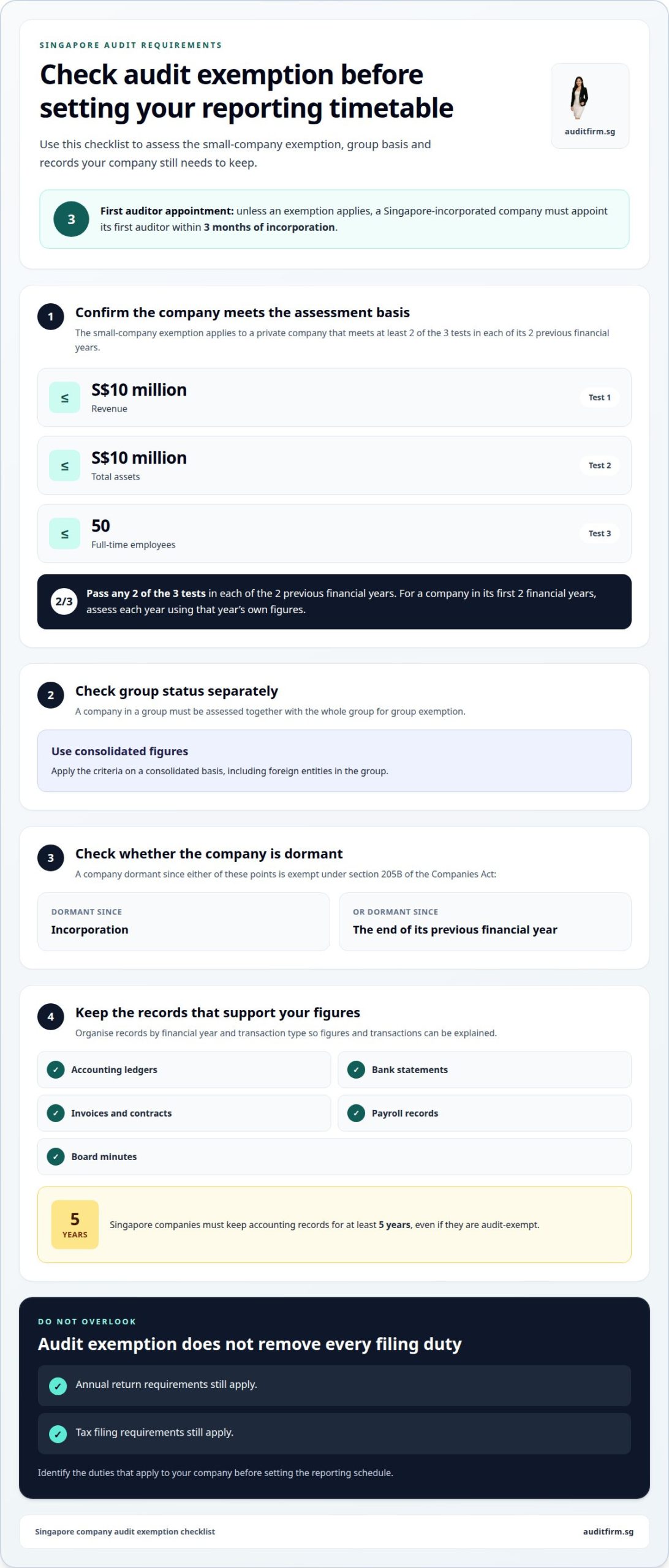
Statutory audits follow Singapore Standards on Auditing, while financial statements use applicable Singapore Financial Reporting Standards. A private company may qualify for the small-company exemption if, for the immediate past two consecutive financial years, it meets at least two tests: revenue no more than S$10 million, total assets no more than S$10 million, and no more than 50 employees. Group companies must meet the criteria on a consolidated basis for group exemption.
Auditor Selection and Appointment
Choose an auditor with relevant experience, independence and a clear understanding of your reporting needs. Agree on the scope, required records and timetable before fieldwork begins. Unless exempt, the company must appoint its first auditor within three months after incorporation. An external auditor independently examines financial statements; an internal audit is conducted for management and can review controls and operations.
If a company misses a required audit or filing, it has not met its statutory obligations. Audit-exempt companies still have annual return and tax filing requirements, so identify the duties that apply before setting your reporting schedule.
Small company audit exemption thresholds
A Singapore private company qualifies for the small-company audit exemption if it meets at least two of three tests for each of its two previous financial years: revenue of S$10 million or less, total assets of S$10 million or less, and no more than 50 full-time employees. Companies in their first two financial years are assessed using each year’s own figures.
For a group exemption, assess the company together with the whole group on a consolidated basis, including foreign entities. A company dormant since formation, or since the end of its previous financial year, is exempt under section 205B of the Companies Act.
Your auditor will generally need records that explain the figures and transactions, such as accounting ledgers, bank statements, invoices, contracts, payroll records and board minutes. According to the Accounting and Corporate Regulatory Authority, Singapore companies must keep accounting records for at least five years, even if audit-exempt.
Organise records by financial year and transaction type to make reporting clearer. An audit exemption removes the statutory audit requirement, but not annual return or tax filing duties. A Singapore audit firm can review the records against the exemption basis and identify gaps that may affect reporting.
Business audit services in Singapore
A business audit examines a company’s financial information and processes. It can identify incomplete reconciliations, unsupported transactions or control gaps before financial statements are finalised. For example, an auditor may trace sales from invoices to accounting records and compare recorded bank balances with bank statements. Businesses seeking professional audit services in Singapore can use the review to address discrepancies and prepare clearer reports for stakeholders.
Plan the audit around the company’s financial year-end and filing timetable. A non-listed Singapore company generally files its annual return no later than 7 months after year-end when an AGM isn’t required. If it holds an AGM, filing is due within one month after that meeting. Early coordination gives the auditor time to review records, raise queries and complete the report before relevant deadlines.
A business audit typically begins with agreeing on the scope and timing, followed by a review of accounting records and supporting documents. The auditor follows up on items needing explanation and considers whether the financial statements comply with applicable reporting standards. A business audit does not replace a statutory audit when one is legally required. Professional audit services can also help Singapore businesses address reporting issues and review internal controls before year-end reporting is complete.
MCST audit in Singapore
An MCST audit examines a Management Corporation Strata Title’s accounts, including income collected, payments made and balances held. For example, the auditor may compare recorded maintenance contributions with bank deposits, then trace contractor payments to invoices and approvals. This helps the council understand whether transactions are supported and clearly recorded.
Prepare by organising records for the audit period. Gather bank statements, general ledger exports, invoices, receipts, contracts, payment records and relevant council minutes, grouped by account or transaction type. For repair payments, link the invoice, approval and payment record so the auditor can follow the transaction without repeated queries. Explain unusual entries or changes in account balances.
The auditor reviews the information, asks follow-up questions and reports findings based on the work performed. A clear handover helps the council respond promptly and keeps the review moving. Assign a contact person to coordinate document requests, track outstanding items and relay questions to the relevant council members or managing agent. This practical process supports reliable accounts and gives stakeholders a clearer view of the MCST’s financial position.
Special purpose, compliance, forensic, and tax audits
A special purpose audit focuses on a defined question, such as checking selected transactions or financial statements prepared for a specific use. A compliance audit examines whether a company follows applicable laws and regulations, often in regulated industries. A forensic audit investigates suspected irregularities, such as unexplained payments. The scope and records reviewed depend on the issue being examined.
For an audit timeline, allow time for the auditor to review records, raise queries and complete the report. The industry-standard duration is 4 to 8 weeks. A prompt response to requests can support efficiency, but incomplete records or complex transactions may require further review. Schedule the work around your financial year-end and reporting deadlines.
For non-listed companies, the annual return is due no later than 7 months after the financial year-end if an AGM isn’t required. If the company holds an AGM, it must file within one month after the AGM. Tax filing deadlines should be checked against the requirements that apply to the company. Tax planning helps organise financial affairs around tax obligations, while a tax audit examines relevant records. An audit exemption doesn’t remove tax return filing duties.
Audit and accounting services
Good accounting records support timely financial reporting: reconciliations and document checks can expose gaps before statements are finalised. Regular bank reconciliations, clear invoice records and consistent expense coding help management trace transactions to evidence. For example, matching a supplier invoice to its payment record can clarify an expense before the audit and reduce follow-up queries.
An external auditor reviews financial statements, tests selected transactions and follows up on differences between records and supporting evidence. The audit report helps stakeholders assess the statements and understand the organisation’s financial position. Management can use findings to correct errors, clarify controls and assign follow-up actions before the next reporting cycle.
Accounting services maintain records; an audit independently examines them. For companies subject to statutory audit, both support compliance with the Companies Act by keeping financial information organised for review and reporting. A practical sequence is to close the accounts, reconcile balances, prepare draft statements, provide supporting schedules, then respond to auditor queries. This gives the auditor a clearer basis for testing and helps management address issues while there is still time to amend draft figures. According to the Accounting and Corporate Regulatory Authority (ACRA), companies must keep accounting records for at least five years, even if audit-exempt.
Auditfirm.sg
Auditfirm.sg helps Singapore organisations manage audit work in line with their reporting obligations and deadlines. Its services include Statutory Audit, Clubs, Association & Societies Audit, Group Audit and Non-Profit Audit. The engagement is tailored to your entity and reporting needs. Turn to the firm for an independent review of accounts, group reporting or an audit report for stakeholders.
For professional audit services in Singapore, clear planning connects audit procedures with your reporting requirements. Audit reports are signed by licensed audit professionals registered with ACRA. Work follows Singapore Standards on Auditing and Singapore Financial Reporting Standards as applicable, so the reporting basis matches the organisation’s requirements.
Share your entity type, financial year-end, reporting deadline, group structure and current accounts status. Flag outstanding reconciliations, unusual transactions and prior audit queries. During the audit, the team reviews supporting records, raises questions about differences and follows up on items needing clarification. This practical process is part of professional audit services in Singapore, helping keep requests and responses organised as deadlines approach.
To discuss your audit requirements and timetable, contact Auditfirm.sg.
Frequently Asked Questions
Searching for an audit firm that actually prioritizes your reporting deadlines?
Agree on a schedule with the audit firm before fieldwork begins. Confirm who will coordinate questions, provide requested records and approve draft financial statements. If the council or management team needs to resolve an issue, identify the decision-maker early. These arrangements keep outstanding items visible and make it easier to address delays before they affect your reporting timetable.
Why does your organisation need an external auditor?
An external auditor independently examines financial information, helping stakeholders make informed decisions. The auditor does not prepare management’s records or take over the council’s responsibilities. Instead, the auditor examines evidence and reports an opinion. This separation matters when members, donors, lenders or other stakeholders need confidence that financial statements have been independently examined.
What professional audit services are available in Singapore?
Audit services in Singapore can support different entity types and reporting purposes, including companies, groups with subsidiaries, Management Corporations Strata Title, clubs and societies, non-profits, and gross turnover reporting. Your organisation’s structure and the reason for the audit determine the appropriate scope. Related accounting and tax services can also help coordinate financial records and reporting work.
Which Singapore companies are required to have an annual statutory audit?
Singapore-incorporated companies generally need an annual statutory audit unless they qualify for an exemption. Eligibility depends on the company’s circumstances and, for group exemptions, the wider group’s position. Keep the audit decision separate from other annual duties: exemption from audit does not itself remove annual return or tax filing requirements. Review each obligation against the company’s reporting calendar.
What steps does a professional auditor follow in a Singapore statutory audit?
A professional auditor first considers the company’s reporting context and areas where errors could affect the financial statements. The auditor selects procedures, examines relevant evidence and investigates unusual balances or differences. For example, a material change in an account may call for supporting documents and an explanation. After evaluating the results, the auditor forms an opinion and issues a report on the financial statements.
What risks or penalties apply for failing to meet Singapore audit and filing requirements?
If a company fails to complete a required audit or filing, it has not met its statutory obligations. Audit-exempt companies must still file annual and tax returns.