
Small size does not automatically put a group audit in Singapore outside SSA 600 (Revised). The standard applies when a group audit is performed, while audit exemption depends on whether the group meets Singapore’s exemption criteria.
It’s understandable to ask whether a smaller group needs the same audit process as a larger one. According to the Accounting and Corporate Regulatory Authority (ACRA), a company in a group qualifies for audit exemption only if it qualifies as a small company and the entire group, including foreign entities, meets at least two criteria for the immediate past two consecutive financial years.
This article explains how to assess that starting point and what SSA 600 (Revised) means for group audit scope, planning, risk assessment and auditor accountability. You’ll also see how the group auditor coordinates component work, evaluates evidence and remains responsible for the group audit opinion.
Key Takeaways
- Distinguish the audit of consolidated financial statements from the consolidation process, and understand how component auditor work contributes to the group opinion.
- See why clear, two-way communication helps group and component auditors address findings and coordinate audit work.
- Learn how a risk-based plan shapes the audit scope and directs attention to the group’s financial reporting risks.
- Understand that the group auditor remains accountable for evaluating evidence and resolving concerns before issuing an opinion.
What is the difference between a group audit and a consolidation audit?
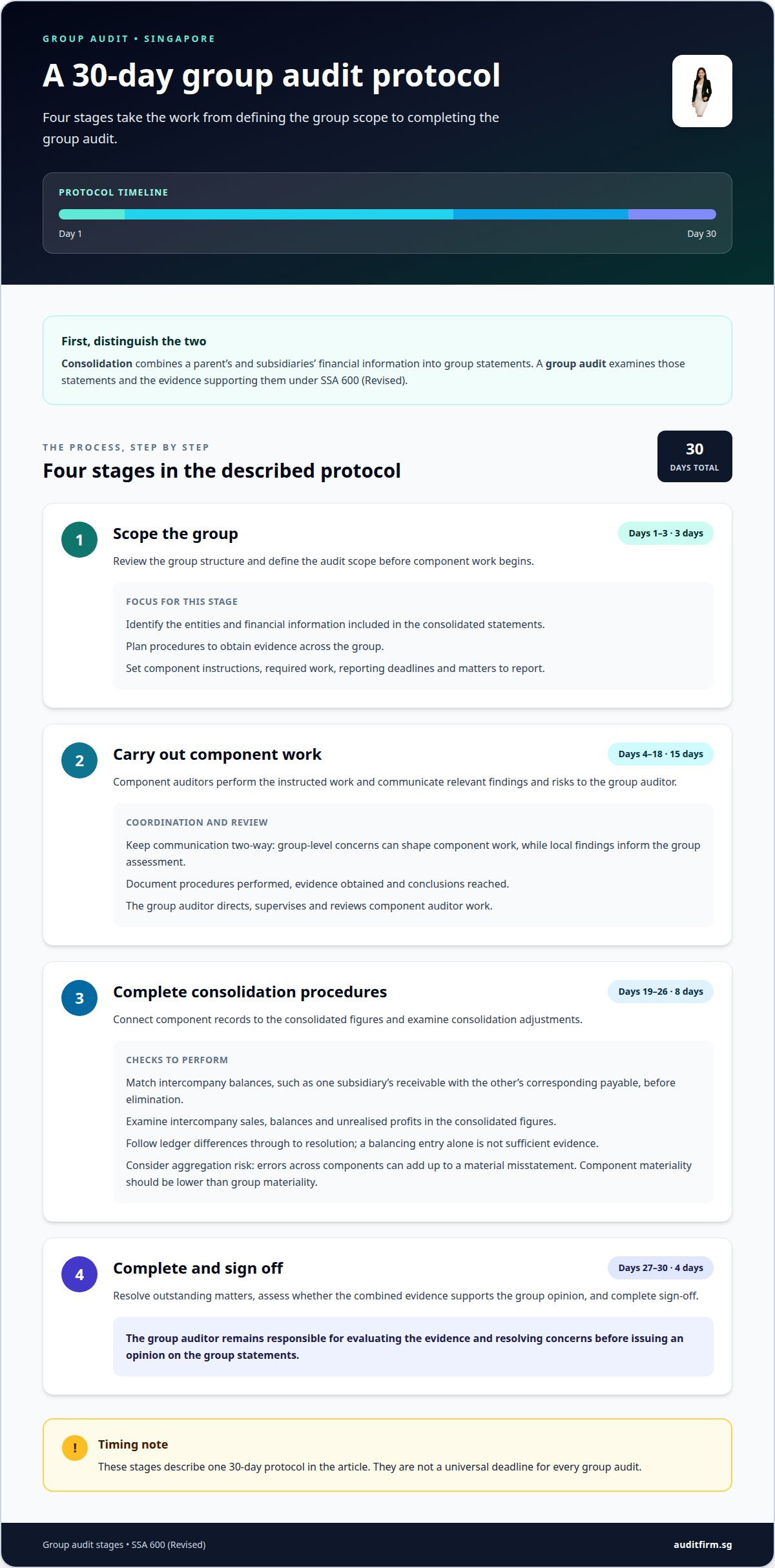
A consolidation combines a parent’s and subsidiaries’ financial information into group statements. A group audit examines those statements and the audit evidence supporting them under SSA 600 (Revised).
Component Work Documentation and Review
The group auditor sets instructions for each component, specifying the work required, reporting deadlines and matters to report. Component auditors communicate findings and risks in both directions, allowing group-level concerns to shape component work and local findings to inform the overall group assessment.
Documentation should enable the group engagement team to understand the procedures performed, evidence obtained and conclusions reached. The group auditor directs, supervises and reviews component auditor work, then assesses whether it supports the group opinion. Look for clear records of instructions, communications, review points and how unresolved matters were handled.
Aggregation Risk and Component Materiality
Small errors in separate components can add up to a material misstatement in the consolidated statements. When setting component materiality, the group auditor considers aggregation risk and how financial information is divided across the group.
Component materiality should be lower than group materiality. Using the same threshold for a component and the group, for example, could leave insufficient room for errors across other components. Reporting should show how component thresholds support the group assessment and how uncorrected misstatements are considered together.
Group and Standalone Audit Requirements
Unlike a standalone company audit, a group audit involves work across components and coordination with component auditors. The group auditor plans the overall approach, communicates instructions, reviews component findings and evaluates whether the combined evidence supports an opinion on the group statements.
A Singapore group audit process can be staged: review the group structure and scope, conduct component work, complete consolidation procedures, then resolve outstanding matters and sign off. One described 30-day protocol allocates days 1-3 to scoping, days 4-18 to component work, days 19-26 to consolidation, and days 27-30 to completion. These are stages in that protocol, not a universal deadline.
Consolidated financial statements and group audit scope
A company’s obligations under Singapore’s Companies Act depend on its applicable statutory and reporting requirements. Group financial statements present a parent and its subsidiaries as one economic entity. Consolidated accounts may use Singapore Financial Reporting Standards or IFRS as their reporting basis, and the auditor assesses whether that basis is applied consistently.
Defining Consolidated Audit Scope
The group auditor identifies the entities and financial information included in the consolidated statements, then plans procedures to obtain evidence across the group. The scope can include component records, consolidation adjustments and group-level disclosures. For example, a subsidiary with material balances may need more audit attention than a component with limited activity.
Look for a clear scope that connects each component’s information to the group statements. The auditor considers each entity’s contribution to the group’s financial position and results, and whether the planned procedures address relevant risks and reporting requirements.
Intercompany Eliminations and Adjustments
Consolidation procedures eliminate balances and transactions between entities in the same group. A receivable recorded by one subsidiary should be matched with the corresponding payable before elimination. The auditor also examines whether intercompany sales, balances and unrealised profits are treated correctly in the consolidated figures.
Adjustment schedules should show the original amounts, entries and supporting records. Differences between entities’ ledgers can point to timing, classification or recording issues. The auditor follows these differences through to resolution rather than treating a balancing entry as sufficient evidence.
Preparing the Consolidation Pack: information your auditor needs from you
A useful audit pack brings together each component’s financial statements, trial balance and reporting schedules. Include intercompany balance reconciliations, consolidation journals, accounting policy information and explanations for material movements. The group auditor uses these records to trace figures from component reporting into the consolidated statements.
Organise the pack by entity and reporting period. For example, label each subsidiary’s trial balance and link its intercompany schedules to the group reconciliation. Clear supporting documents help the auditor trace adjustments and spot missing or inconsistent information.
Consolidation Methods and Reporting Dates
The consolidation method depends on the group’s structure and the accounting framework applied. The auditor reviews how the parent’s interests and each component’s financial information appear in group reporting, including any required equity accounting or foreign currency translation.
Reporting dates matter, too. The auditor considers the periods covered by component statements and how differences affect group reporting. Keep each entity’s reporting period, accounting policies and any date-related adjustments visible in the pack. This gives the auditor a clear basis for testing consolidated figures and disclosures.
Clear component records and reconciliations support focused group reporting review.
Group audit planning and risk assessment
SSA 600 (Revised) uses a risk-based approach rather than the previous standard’s focus on identifying significant components. Its approach aligns with SSA 315 (Revised) and SSA 330. The group auditor sets the overall strategy, identifies components and plans procedures in response to assessed risks across the group.
Planning starts with the group structure and how each component contributes to the financial statements. The auditor considers where material balances, transactions or reporting risks arise, then decides what evidence is needed and where. An illustrative case involved Subsidiary H, which contributed 85% of group revenue and 78% of profits. Those figures show why a component’s effect on group results can shape audit attention.
Risk assessment also considers how financial information moves from components into group reporting. For example, a component with complex transactions or a different operating environment may need procedures focused on those areas. The group auditor uses the assessed risks to determine the nature and extent of the work and whether component auditors need to be involved. The plan should link each identified risk to specific audit procedures and expected evidence.
Cross-border groups can face practical constraints. Overseas component records may be subject to local data privacy laws, access restrictions or jurisdictional differences. These issues can affect how evidence is obtained and reviewed, so the group auditor should account for them during planning, before component work begins.
A clear plan sets out responsibilities, reporting expectations and how findings will be evaluated at group level. For a group audit in Singapore, the auditor considers whether component work addresses the risks identified in the overall strategy. If evidence from a component does not resolve a group-level concern, further procedures may be needed. The scope should reflect the group’s actual risk profile, rather than apply identical work to every entity.
Group auditor accountability and professional skepticism
The group engagement partner remains accountable for the group audit opinion. Component auditors contribute evidence, but their work does not transfer that responsibility. The group auditor assesses whether component findings support conclusions about the group financial statements.
Professional skepticism means investigating information that does not agree. For example, if a component auditor reports no significant issue but group management reports a material dispute, the group auditor should understand the discrepancy. Inconsistent information from component auditors, component management and group management can affect the group financial statements. The engagement team should follow up on conflicting explanations and assess their effect on the audit evidence.
Accountability also means assessing the quality and relevance of component work. A completed report alone may not show whether the component procedures addressed the group’s risks. The group auditor reviews the work performed, considers the evidence obtained and follows up on unresolved findings. If the evidence leaves a group-level question unanswered, the auditor considers further procedures before reaching an opinion.
The specific risk identified under SSA 600 para 12 concerns insufficient appropriate audit evidence. In specified circumstances, the group engagement partner must decline or disclaim an opinion when the group auditor cannot obtain that evidence. This is an audit opinion consequence, not a general penalty amount. The key practical risk is proceeding to sign-off while material questions remain unresolved.
An illustrative case involved a group auditor signing an opinion on 31 March 2015 before outstanding matters were resolved. That example shows why completion requires more than collecting component reports. Before the group opinion is issued, outstanding deliverables and subsequent events reviews should be received and assessed. The group auditor must also consider whether component information conflicts with group-level records or explanations.
Bring unresolved component findings and reporting differences into the engagement process early. Discuss group audit evidence and accountability before sign-off pressures arise.
Auditfirm.sg: Group Audit
Auditfirm.sg provides Group Audit for businesses that need an independent review of financial information across parent and subsidiary entities, and are prepared to produce consolidated financial statements. Use this service when component records, consolidation adjustments and audit evidence need to be assessed as part of the group engagement.
The audit team coordinates its work around the group’s structure and reporting requirements. Prepare by organising each entity’s financial statements, trial balance, intercompany reconciliations and supporting schedules. Clear records help the auditor trace component information into the consolidated statements and follow up on differences.
Auditfirm.sg also provides Statutory Audit, Clubs, Association & Societies Audit and Non-profit audit services in Singapore for organisations with those audit needs. Contact Auditfirm.sg to discuss your group audit requirements.
Prepare the Next Step for Your Group
Your next step is to bring your group’s audit needs into one clear discussion. For a group audit in Singapore, outline the entities involved, the reporting period and any outstanding matters. This gives the audit team a practical starting point for discussing scope and coordination.
Auditfirm.sg provides Group Audit, Statutory Audit and Clubs, Association & Societies Audit. Its qualified auditors can discuss the records and arrangements relevant to your engagement. Share your group structure and reporting concerns so the discussion can focus on your situation.
Starting that discussion early can help you plan responsibilities and keep the audit process moving. Contact Auditfirm.sg about group audit services to take the next step with clarity.
Frequently Asked Questions
Does SSA 600 (Revised) apply to small groups?
Yes. SSA 600 (Revised) applies when group financial statements are audited, including engagements involving component auditors. Group size alone does not decide whether the standard applies. Audit exemption is a separate question. According to ACRA, a company in a group must qualify as a small company, and the entire group must meet at least two exemption criteria in each of the two immediately preceding financial years.
Looking for a Trusted Group Audit Partner in Singapore?
Auditfirm.sg provides Group Audit for organisations that own or control one or more subsidiaries and are prepared to produce consolidated financial statements. The work can include coordination with component auditors and review of consolidation adjustments. To begin, outline your group structure, reporting period, component auditor involvement and available records for the consolidated statements.
When Does a Singapore Company Need a Consolidation Audit?
A company needs an audit of consolidated accounts when applicable statutory or reporting obligations require those statements to be audited. For a group audit in Singapore, the engagement examines the group statements and the evidence supporting them. Consolidation is the accounting process; an audit is an independent examination. The reporting basis and any applicable audit exemption affect the scope.
When is a group audit required in Singapore?
A group audit in Singapore is required when applicable obligations require audited group financial statements. Having a parent and subsidiaries does not, by itself, establish whether an audit exemption applies. Assess the reporting requirement and exemption position for both the company and the entire group. ACRA states that a company in a group must qualify as a small company, while the entire group must meet the relevant criteria.
What are the auditor’s responsibilities in a Singapore group audit under SSA 600?
The group auditor is responsible for the group audit opinion and must assess whether the available evidence supports it. This includes evaluating component auditor work and resolving concerns. For example, if a component report conflicts with information from group management, the group auditor investigates the difference and considers its effect on the group statements before signing an opinion.
How does a Singapore group auditor assess and direct component auditors?
The group auditor considers each component’s risks and the quality and relevance of its audit work. Instructions set out the procedures, reporting expectations and matters to communicate. The group auditor and component auditors exchange findings and questions during the engagement. For overseas components, local data privacy rules or access restrictions may affect how the auditor obtains and evaluates evidence.