
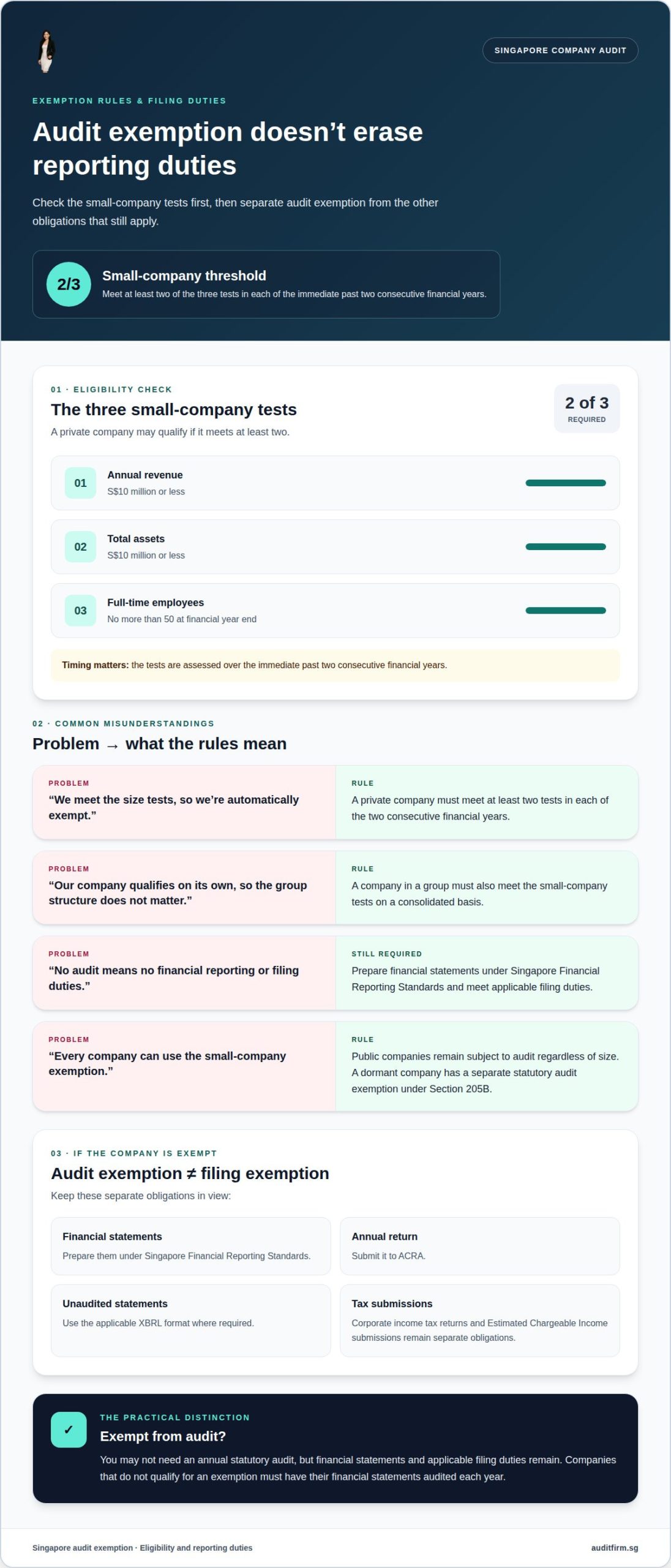
An audit exemption does not remove every filing duty. For a business audit in Singapore, a private company may qualify as a small company if it meets at least two of three tests: annual revenue of S$10 million or less, total assets of S$10 million or less, and no more than 50 full-time employees. The tests are assessed over the immediate past two consecutive financial years.
That distinction matters: a public company remains subject to audit regardless of size, while a company that is not exempt must have its financial statements audited each year. You’ll learn how the exemption tests apply, which duties remain if a company is exempt, what an independent auditor does, and who is legally qualified to conduct a statutory audit. This will help you understand your company’s requirements and plan for its reporting obligations.
Key Takeaways
- Assess whether your company meets the small-company exemption tests, and account for the consolidated group test if it belongs to a group.
- Separate audit exemption from other reporting duties; exemption does not remove every statutory filing obligation.
- Understand how auditor independence protects the audit, including why the auditor must not prepare the accounts for the same statutory audit engagement.
- Confirm that a statutory audit is conducted by an ACRA-registered Public Accountant practising through a registered public accounting entity.
What are the audit exemptions in Singapore?
Singapore companies may qualify for a statutory audit exemption under specific rules, but exemption does not remove financial reporting duties. A private company can qualify as a small company if it meets at least two of three tests in each of the immediate past two consecutive financial years.
The tests assess annual revenue of S$10 million or less, total assets of S$10 million or less, and no more than 50 full-time employees at financial year end. A company in a group must also meet the small-company tests on a consolidated basis. Public companies, including those listed on the Singapore Exchange, remain subject to audit regardless of size.
There is also a dormant-company exemption. Under Section 205B of Singapore’s Companies Act, a dormant company is exempt from the statutory audit requirement, according to Singapore Statutes Online. Companies that do not qualify for an exemption must prepare audited financial statements each year.
Audit exemption does not mean exemption from reporting. Companies must still prepare financial statements under Singapore Financial Reporting Standards and meet applicable filing duties. Annual returns go to ACRA, with unaudited statements in the applicable XBRL format where required. Corporate income tax returns and Estimated Chargeable Income submissions remain separate obligations.
For an audit, the core deliverables are the audited financial statements and the external auditor’s report. The report sets out the auditor’s opinion and its basis, then describes the responsibilities of the directors and auditor. These deliverables support corporate reporting to shareholders and relevant filing processes.
Audit reports also identify accountability. Companies Act amendments that took effect in May 2026 require statutory audit reports to identify the individual public accountant primarily responsible for the audit. This helps readers see who led the work behind the opinion. The report assesses the financial statements against applicable accounting and auditing standards; it does not replace directors’ responsibility for the company’s records.
External auditor responsibilities and independence
An external auditor independently examines a company’s financial statements and supporting evidence. This work supports reliable reporting, but directors remain responsible for the statements.
For a statutory audit, the auditor assesses whether the statements are free from material misstatement and comply with applicable reporting requirements. The auditor gathers evidence, tests selected transactions and considers whether the accounting records support the reported figures. For example, a revenue balance may be checked against invoices and customer receipts. The opinion provides reasonable assurance, not a guarantee that every fraud or error will be found.
Professional Scepticism and Independent Certification
Professional scepticism means questioning evidence and carefully examining explanations. It matters because company records may contain errors, unusual transactions or unsupported assumptions that affect the financial statements.
Independence also applies to certification assessments, which examine whether operations follow a selected set of standards. An external group can review documents, observe work and ask staff questions. For example, a certifier may compare written procedures with actual work practices. The company receives certification when all parts of the assessment meet the applicable rules.
Independent Assurance and Reviews
Independent assurance is an external assessment of information that helps users judge whether it is reliable. A review provides an independent examination of statements, while a statutory audit involves gathering evidence to support an audit opinion.
This distinction matters when companies plan financial-year reporting and filing. A review does not replace a statutory audit when one is required. Singapore public accountants must follow the Code of Professional Conduct and Ethics, complete continuing professional education, and submit audit work for inspection under ACRA’s Practice Monitoring Programme.
Independence also means the auditor cannot prepare accounts for the same statutory audit engagement. Combining account preparation and audit work would compromise the auditor’s independence. Keep those responsibilities separate, and provide the auditor with records and explanations needed to assess the statements. For statutory audit support, maintain a clear separation between preparing accounts and examining them.
Who Can Legally Audit Your Company?
A statutory audit is an independent examination of financial statements that results in an auditor’s opinion. In Singapore, the appointment must meet registration and independence requirements.
Only an ACRA-registered Public Accountant practising through a registered public accounting entity may perform a Singapore statutory audit. Public accountants register under the Accountants Act to provide auditing and financial statement reporting services. This ensures that the person signing the opinion is authorised to conduct the work.
Statutory and Voluntary Audits
A statutory audit is required by law when a company does not qualify for an exemption; a voluntary audit is commissioned when no statutory audit is required. This distinction helps you determine whether an audit is a legal obligation or a choice for corporate reporting.
Companies that are not audit-exempt must have their financial statements audited annually. A voluntary audit can provide independent assurance to shareholders or other users, but it does not replace separate tax filing duties. A tax audit concerns tax matters, while an internal audit examines company processes and controls. A financial statement review is a different form of independent work.
Audit Standards, Appointments, and Filing Deadlines
Singapore statutory audits follow the Singapore Standards on Auditing issued by the Institute of Singapore Chartered Accountants. Company statements are prepared under the Singapore Financial Reporting Standards. The Companies Act 1967 sets statutory audit obligations, while the financial year shapes the company’s reporting and filing timetable.
A company requiring an audit must appoint an auditor within three months of incorporation. If an auditor resigns, the company must hold a general meeting within three months of receiving the resignation notice to appoint a replacement. It must notify ACRA within 14 days of the replacement appointment. For removal and replacement, it must notify ACRA within 14 days of the removal and new appointment.
Singapore-incorporated subsidiaries follow the applicable company audit rules. A company in a group can use the small-company exemption only if the group meets at least two tests on a consolidated basis. Foreign ownership alone does not establish eligibility for exemption.
Companies must file Annual Returns with ACRA within seven months of their financial year end. Late filing penalties can range from S$300 to S$3,000, depending on the delay. Meeting audit and filing dates helps keep corporate reporting on schedule.
Singapore statutory audit requirements and exemptions
Singapore-incorporated companies generally need audited financial statements unless they qualify for an exemption. For subsidiaries, assess eligibility at both company and group level before setting the audit timetable.
A private company may qualify as a small company by meeting at least two of three criteria: annual revenue of S$10 million or less, total assets of S$10 million or less, and no more than 50 full-time employees at financial year end. The assessment covers the immediate past two consecutive financial years. Revenue is only one test, so being below its threshold alone does not establish exemption. Check the other financial measures and employee count as well.
Group membership adds a consolidated assessment. A company belonging to a group can claim the exemption only if the group meets at least two of the three tests on a consolidated basis. A subsidiary’s standalone figures therefore do not settle eligibility. The parent and relevant group figures, including revenue, assets and employee numbers, also matter.
Eligibility can change. A company that stops meeting the small-company criteria for two consecutive financial years no longer qualifies for the audit exemption. Reassess company and group figures each financial year, especially after revenue growth, an acquisition or a change in headcount. A previously exempt subsidiary may then need an annual statutory audit.
Thresholds also need a date check. ACRA announced a review of Singapore’s audit-exemption thresholds in February 2026; as of mid-2026, no new thresholds had been enacted, and the S$10 million limits remained in force. Public companies, including those listed on the Singapore Exchange, remain subject to audit regardless of size. Shareholders holding at least 5% of total voting rights can also require an audit by giving written notice at least 14 days before financial year end.
Exemption does not remove reporting duties. Companies still prepare financial statements and meet applicable statutory filing requirements. For a group, record each subsidiary’s status and reassess it alongside consolidated results. Arrange a statutory audit assessment when a company or group no longer meets the exemption criteria.
Auditfirm.sg
Auditfirm.sg helps Singapore companies address audit requirements across subsidiaries and group entities. Its Group Audit and Statutory Audit services support businesses assessing which entities need an audit and how group reporting fits together.
Turn to Auditfirm.sg when a subsidiary no longer meets the exemption criteria, group results affect eligibility, or reporting deadlines need attention. The firm’s audits follow Singapore Standards on Auditing (SSA) and Financial Reporting Standards (FRS). Audit reports are signed by licensed audit professionals registered with ACRA.
For group entities, clear records and timely information from each company help the audit team assess the financial statements and plan its work. Auditfirm.sg also provides Clubs, Association & Societies Audit and Non-Profit Audit for organisations with those reporting needs.
Contact Auditfirm.sg to discuss your company’s audit requirements.
Plan the next audit cycle with confidence
Use your exemption assessment to shape the group’s next reporting plan. For a business audit in Singapore, set a shared timetable across subsidiaries, assign a contact for each entity, and agree how financial records will be gathered. Clear responsibilities help prevent late information from one company disrupting the wider group’s audit work.
Auditfirm.sg provides Statutory Audit and Group Audit services, as well as Clubs, Association & Societies Audit. Its qualified auditors help companies address audit and reporting requirements across different entities. Planning a business audit in Singapore also means accounting for each subsidiary’s reporting context.
Audit planning is easier when the next steps are clear. Contact Auditfirm.sg about your audit to discuss the requirements for your company or group. With a practical plan in place, you can move forward with greater clarity.
Frequently Asked Questions
What Is a Financial Statement Audit?
A financial statement audit is an independent examination of a company’s financial information and supporting records. It helps users assess whether the statements present the company’s financial position and performance in line with applicable reporting requirements. For example, the auditor may trace figures in the accounts to underlying records. The completed audit communicates an opinion on the statements.
What do I need to give the auditor?
Provide the records needed to understand the company’s transactions and balances for the financial year. These commonly include the trial balance, general ledger, bank statements, sales and purchase invoices, contracts, and relevant board minutes. For a group, include subsidiary reporting information and details of intercompany balances. Organised files and clear responses to audit queries help the auditor follow the evidence.
What does an auditor test during an audit?
An auditor tests selected transactions and account balances against supporting evidence. For example, testing may trace sales entries to invoices and receipts, or compare recorded expenses with supplier documents. The auditor also considers whether accounting estimates and disclosures are adequately supported. The nature and extent of testing depend on the statements, identified risks, and evidence available for the financial year.
Which Singapore companies are required to have an annual statutory audit?
Singapore-incorporated companies generally need annual audited financial statements unless they qualify for an exemption under the Companies Act or meet the dormant-company exemption. Public companies, including listed companies, are subject to audit regardless of size. For a subsidiary, consider its legal status and group position rather than relying only on the parent company’s audit or reporting arrangements.
What are the Singapore small-company audit exemption criteria and thresholds?
A Singapore private company must meet at least two of these tests for the immediate past two consecutive financial years: annual revenue of S$10 million or less, total assets of S$10 million or less, and no more than 50 full-time employees at financial year end. Group companies must also meet at least two tests on a consolidated basis. Reassess eligibility as company and group figures change.