
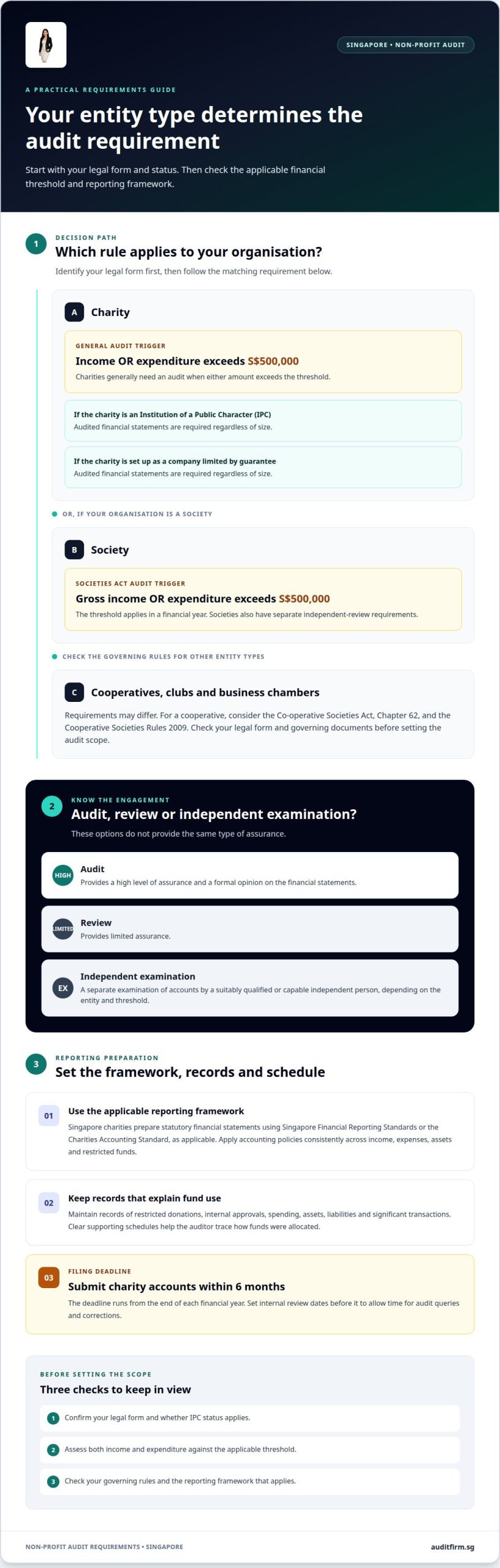
A charity in Singapore generally needs an audit when its income or expenditure exceeds S$500,000, while Institutions of a Public Character and charities set up as companies limited by guarantee require audited financial statements regardless of size.
Societies have a separate threshold: according to the Registry of Societies, Singapore, a society must be audited under the Societies Act if its gross income or expenditure exceeds S$500,000 in a financial year, so your legal form matters when planning a non-profit audit in Singapore.
This guide explains how non-profit audit requirements in Singapore differ for charities, companies limited by guarantee and societies, and what to consider when preparing financial records under the applicable reporting framework.
Key Takeaways
- Identify your charity’s legal form and status first, as these can affect whether a full audit is required.
- Societies have separate audit and independent-review requirements, so assess both income and expenditure against the applicable threshold.
- Choose the applicable reporting framework, such as the Charities Accounting Standard or Singapore Financial Reporting Standards, for your organisation’s accounts.
- Prepare clear financial records ahead of reporting deadlines to support a smoother audit and transparent reporting.
Does my charity need an audit?
In Singapore, audit requirements depend on an organisation’s legal form, status and financial activity. Check these factors alongside the applicable reporting framework and governance rules.
Audit Requirements by Entity Type
Charities, societies, cooperatives, clubs and business chambers may face different requirements under their governing rules. Charities generally need an audit when income or expenditure exceeds S$500,000; Institutions of a Public Character and charities set up as companies limited by guarantee require audited financial statements regardless of size. According to the Registry of Societies, Singapore, a society must be audited under the Societies Act if its gross income or expenditure exceeds $500,000 in a financial year. Cooperatives should also consider the Co-operative Societies Act, Chapter 62, and the Cooperative Societies Rules 2009. Check your entity’s legal form and governing documents before setting the audit scope.
Registration and IPC Audit Requirements
Charity registration and IPC status bring regulatory and reporting obligations. IPCs require an independent audit regardless of legal form, while a charity applying for registration or IPC status should plan for its accounts to be audited. The Charities Act and applicable governance code are relevant to charities; registered societies also follow their own governance requirements. The board should identify the applicable framework and keep records of restricted donations, internal approvals and fund use. These records help show donors how funds support the charity’s stated purposes.
Audit, Examination, and Review Options
An audit provides a high level of assurance and a formal opinion on financial statements. A review provides limited assurance. An independent examination is a separate examination of accounts by a suitably qualified or capable independent person, depending on the entity and threshold.
Missing an audit or filing obligation can lead to regulatory consequences under the rules governing that entity. The applicable penalty depends on the breach and legal form. A professional auditor can explain the required scope, assess records and reporting needs, and support an orderly appointment or auditor change. Agree on responsibilities and provide prior reports and accounting records early.
Companies limited by guarantee and audit compliance
A charity set up as a company limited by guarantee has company reporting duties alongside charity requirements. Clear records and a planned reporting schedule support compliance.
Audit Documentation and Deadlines
Keep accounting records that support donations, spending, assets and liabilities. Prepare the financial statements and supporting schedules for the external auditor, including records of restricted funds and significant transactions. The Companies Act governs companies limited by guarantee, while ACRA oversees their company registration. According to the Commissioner of Charities, Singapore, charities must submit their accounts within 6 months after the end of each financial year. Set internal review dates before that deadline to allow time for audit queries and corrections.
Audit Completion Timelines
Audit completion depends on the quality and availability of records, the complexity of transactions and how quickly the organisation responds to requests. A charity with several programmes or restricted donations may need to explain how funds were allocated. An external auditor examines the statements and issues a report stating whether they present a true and fair view. Resolve missing schedules and unclear entries promptly to keep the work moving toward the charity’s filing deadline, without assuming a fixed audit duration.
SFRS and CAS Compliance
Use the reporting framework that applies to the organisation. Singapore charities prepare statutory financial statements using Singapore Financial Reporting Standards or the Charities Accounting Standard, as applicable. The chosen framework shapes how accounting items appear in the statements, so consistent treatment supports transparency about the charity’s mission and funds. The auditor considers the statements against that framework and relevant regulatory requirements. Aligning records with the applicable standard helps the board explain financial information to donors and maintain a clear audit trail.
Singapore non-profit financial reporting frameworks
Start with the framework that applies to your organisation. Singapore charities prepare statutory financial statements using Singapore Financial Reporting Standards or the Charities Accounting Standard, as applicable. Apply the chosen accounting policies consistently across income, expenses, assets and restricted funds. For example, record a donation restricted to a programme separately from unrestricted operating funds. This makes the purpose and treatment of each amount easier to trace in financial reporting.
Good governance connects financial statements to board decisions. The Code of Governance for Charities and IPCs provides a framework for charity governance, including accountability and responsible financial management. Set clear approval steps for spending, document conflicts of interest and review financial reports at board meetings. These practices help trustees track whether spending follows approved budgets and the charity’s mission. A non-profit audit in Singapore examines reported figures and controls, helping identify gaps that may need attention.
Clear reporting also helps donors understand how an organisation manages its funds. Present programme spending, administrative expenses and restricted donations in a consistent format, then explain material changes in the annual report. Charities with gross receipts or total expenditure of S$500,000 and above, and all IPCs, must disclose a reserves policy in their annual report. IPC status also matters to donors: donations to a charity without approved IPC status, or for a foreign charitable purpose, are not tax-deductible. Accurate financial statements support transparency, but they should also match the organisation’s actual records and governance decisions.
Singapore society audit thresholds
For a Singapore society, the threshold depends on gross income or total expenditure for the financial year. At S$250,000 or less, an independent review applies. From S$250,001 to S$500,000, the review must be by an ISCA member. Above S$500,000, the society must be audited under the Societies Act. Use whichever measure is higher: gross income or total expenditure. The threshold is not based on surplus or profit.
That distinction matters for societies raising donations, collecting membership fees or managing restricted funds. A society can have modest net income but still cross a threshold through its total expenditure. Track both figures in the accounts and keep records showing how restricted funds were received and spent. Clear records of payments, approvals and fund use also help assess internal controls.
Society registration does not itself make an organisation an Institution of a Public Character. IPC status brings separate charity obligations, so identify whether your organisation is also registered as a charity or holds public character status. The relevant rules depend on that status as well as the society threshold. Societies also submit annual returns to the Registry of Societies, making accurate financial reporting part of routine administration in Singapore’s non-profit sector.
Use the threshold to plan the right level of independent scrutiny before preparing your accounts. Gather bank records, donation schedules, payment support and explanations for material changes. For example, a society with high programme spending should reconcile expenditure to its accounting records, even if its operating surplus is small. An audit provides a formal opinion; an independent review is a different level of assurance. Choose the required process based on the society’s financial figures and regulatory status, not its size or charitable purpose alone.
Auditfirm.sg: Non-Profit Audit
Auditfirm.sg supports Singapore charities and other non-profits with audit work suited to their legal form and reporting needs. Its Non-Profit Audit examines financial statements, donations and use of funds. The work can help clarify whether records support reported activity and identify matters requiring attention before accounts are finalised.
For societies, clubs and associations, the Clubs, Association & Societies Audit addresses the organisation’s accounts and applicable reporting obligations. A company limited by guarantee may need a Statutory Audit under company requirements. Where a non-profit forms part of a group, Group Audit work can address financial information across the relevant entities. The right scope depends on your structure and reporting responsibilities.
Auditfirm.sg’s qualified auditors work with financial records and supporting documents, including donation schedules, expenditure details and explanations for restricted funds. They follow Singapore Standards on Auditing and apply the Charities Accounting Standard or Singapore Financial Reporting Standards as applicable. Audit reports are signed by licensed audit professionals registered with ACRA. Auditfirm.sg has audited charities, societies, IPCs and religious bodies, bringing experience with different non-profit structures and reporting needs.
Before work begins, gather the trial balance, ledgers, bank records, prior financial statements and schedules supporting significant balances. Clear explanations of programme spending and donation restrictions help the auditor understand how funds were recorded and used. Agreeing on responsibilities and sharing complete records early can help avoid delays caused by missing information. The audit also considers whether financial statements present a true and fair view, based on the work performed and applicable reporting framework.
For an audit suited to your organisation’s obligations, contact Auditfirm.sg.
Frequently Asked Questions
More Information on NPO Audit?
A non-profit audit in Singapore examines financial statements and supporting records, including how donations were recorded and used. For example, the auditor may trace a restricted donation from receipt to spending on its designated programme. The audit also considers whether the statements present a true and fair view. Organise records by fund and programme so each transaction can be followed clearly.
Which Singapore charities and non-profit organisations are required to have an audit?
Audit duties depend on legal form, charity status and financial activity. Charities generally require an audit when income or expenditure exceeds S$500,000. Institutions of a Public Character and charities formed as companies limited by guarantee require audited financial statements regardless of size. A society follows its own income and expenditure thresholds. Check whether your organisation has more than one status, since separate obligations may apply.
What are the audit and financial reporting requirements for Singapore charities under the Charities Act?
Singapore charities must meet applicable audit and financial reporting duties, and prepare statements using the Charities Accounting Standard or Singapore Financial Reporting Standards, as applicable. They must submit their accounts within 6 months after the end of each financial year, according to the Commissioner of Charities, Singapore. Keep approved accounts, supporting schedules and explanations for material transactions together for reporting and audit work.
What are the audit requirements for societies and companies limited by guarantee in Singapore?
A society must be audited under the Societies Act if its gross income or expenditure exceeds S$500,000 in a financial year, according to the Registry of Societies, Singapore. A society below that threshold may instead need an independent review, depending on its figures. A charity constituted as a company limited by guarantee must have audited financial statements. Coordinate its company records and charity reporting obligations.
What are the audit exemption thresholds for Singapore non-profit organisations?
There is no single exemption threshold for every non-profit. For a society, gross income or expenditure of S$250,000 or less calls for an independent review; between S$250,001 and S$500,000, an ISCA member must conduct the review. Above S$500,000, an audit applies. Other charities may have examination options at lower levels, but IPCs and companies limited by guarantee still require audits.
What financial statements and records must a Singapore charity prepare for an audit?
For a non-profit audit in Singapore, prepare financial statements under the applicable reporting framework and organise the records supporting each balance. Useful documents include the trial balance, general ledger, bank statements, donation schedules, invoices, payment records and explanations for restricted funds. For example, match a programme grant to its receipt and related spending. Board approvals and prior-year statements can help explain decisions and changes.